Jonah 1:1-17 Now the word of Yahweh came to Jonah the son of Amittai, saying, “Arise, go to Nineveh, that great city, and preach against it, for their wickedness has come up before me.” But Jonah rose up to flee to Tarshish from the presence of Yahweh. He went down to Joppa, and found a ship going to Tarshish; so he paid its fare, and went down into it, to go with them to Tarshish from the presence of Yahweh. But Yahweh sent out a great wind on the sea, and there was a mighty storm on the sea, so that the ship was likely to break up. Then the mariners were afraid, and every man cried to his god. They threw the cargo that was in the ship into the sea to lighten the ship. But Jonah had gone down into the innermost parts of the ship, and he was laying down, and was fast asleep. So the shipmaster came to him, and said to him, “What do you mean, sleeper? Arise, call on your God! Maybe your God will notice us, so that we won’t perish.” They all said to each other, “Come, let us cast lots, that we may know who is responsible for this evil that is on us.” So they cast lots, and the lot fell on Jonah. Then they asked him, “Tell us, please, for whose cause this evil is on us. What is your occupation? Where do you come from? What is your country? Of what people are you?” He said to them, “I am a Hebrew, and I fear Yahweh, the God of heaven, who has made the sea and the dry land.” Then were the men exceedingly afraid, and said to him, “What is this that you have done?” For the men knew that he was fleeing from the presence of Yahweh, because he had told them. Then they said to him, “What shall we do to you, that the sea may be calm to us?” For the sea grew more and more stormy. He said to them, “Take me up, and throw me into the sea. Then the sea will be calm for you; for I know that because of me this great storm is on you.” Nevertheless the men rowed hard to get them back to the land; but they could not, for the sea grew more and more stormy against them. Therefore they cried to Yahweh, and said, “We beg you, Yahweh, we beg you, don’t let us die for this man’s life, and don’t lay on us innocent blood; for you, Yahweh, have done as it pleased you.” So they took up Jonah, and threw him into the sea; and the sea ceased its raging. Then the men feared Yahweh exceedingly; and they offered a sacrifice to Yahweh, and made vows. Yahweh prepared a great fish to swallow up Jonah, and Jonah was in the belly of the fish three days and three nights.
Romans 13:8-10 Owe no one anything, except to love one another; for he who loves his neighbor has fulfilled the law. For the commandments, “You shall not commit adultery,” “You shall not murder,” “You shall not steal,” “You shall not give false testimony,” “You shall not covet,” and whatever other commandments there are, are all summed up in this saying, namely, “You shall love your neighbor as yourself.” Love doesn’t harm a neighbor. Love therefore is the fulfillment of the law.
Matthew 8:23-27 When he got into a boat, his disciples followed him. Behold, a violent storm came up on the sea, so much that the boat was covered with the waves, but he was asleep. They came to him, and woke him up, saying, “Save us, Lord! We are dying!” He said to them, “Why are you fearful, O you of little faith?” Then he got up, rebuked the wind and the sea, and there was a great calm. The men marveled, saying, “What kind of man is this, that even the wind and the sea obey him?”
What are you afraid of? Are you afraid of losing your job? Are you afraid people won't like you? Do you fear for your family? Are you afraid of dying? We have such little faith. We are afraid of so many things even though Jesus who even the wind and sea obey is here with us. Jesus does not always stop the wind and the sea but He gives us peace in the midst of the wind and the sea. He may not keep the wind and the sea from killing us but He gives us life.
Jesus suffered the drowning that we deserve. Jesus was cast into the sea of our sin in His baptism and cleansed the waters by taking our sin upon Himself. He drowned in your sins at His crucifixion and spent three days in the belly of the earth so that you will be a partaker in His resurrection. Do not be afraid. Jesus--the One who controls the wind and the sea died for you and will keep you to the end.
THE ONLY BLOG TO WIN ISSUES ETC. BLOG OF THE WEEK AND BE NOMINATED FOR ISSUES ETC. SOUNDBITE OF THE WEEK WITH A SINGLE POST
Sunday, January 30, 2011
Sunday, January 23, 2011
Epiphany 3: A Devotional Commentary
2 Kings 5:1-15 Now Naaman, captain of the army of the king of Syria, was a great man with his master, and honorable, because by him Yahweh had given victory to Syria: he was also a mighty man of valor, but he was a leper. The Syrians had gone out in bands, and had brought away captive out of the land of Israel a little maiden; and she waited on Naaman’s wife. She said to her mistress, “I wish that my lord were with the prophet who is in Samaria! Then he would heal him of his leprosy.” Someone went in, and told his lord, saying, “The maiden who is from the land of Israel said this.” The king of Syria said, “Go now, and I will send a letter to the king of Israel.” He departed, and took with him ten talents of silver, and six thousand pieces of gold, and ten changes of clothing. He brought the letter to the king of Israel, saying, “Now when this letter has come to you, behold, I have sent Naaman my servant to you, that you may heal him of his leprosy.” It happened, when the king of Israel had read the letter, that he tore his clothes, and said, “Am I God, to kill and to make alive, that this man sends to me to heal a man of his leprosy? But please consider and see how he seeks a quarrel against me.” It was so, when Elisha the man of God heard that the king of Israel had torn his clothes, that he sent to the king, saying, “Why have you torn your clothes? Let him come now to me, and he shall know that there is a prophet in Israel.” So Naaman came with his horses and with his chariots, and stood at the door of the house of Elisha. Elisha sent a messenger to him, saying, “Go and wash in the Jordan seven times, and your flesh shall come again to you, and you shall be clean.” But Naaman was angry, and went away, and said, “Behold, I thought, ‘He will surely come out to me, and stand, and call on the name of Yahweh his God, and wave his hand over the place, and heal the leper.’ Aren’t Abanah and Pharpar, the rivers of Damascus, better than all the waters of Israel? Couldn’t I wash in them, and be clean?” So he turned and went away in a rage. His servants came near, and spoke to him, and said, “My father, if the prophet had asked you do some great thing, wouldn’t you have done it? How much rather then, when he says to you, ‘Wash, and be clean?’” Then went he down, and dipped himself seven times in the Jordan, according to the saying of the man of God; and his flesh was restored like the flesh of a little child, and he was clean. He returned to the man of God, he and all his company, and came, and stood before him; and he said, “See now, I know that there is no God in all the earth, but in Israel. Now therefore, please take a gift from your servant.”
Romans 12:16-21 Be of the same mind one toward another. Don’t set your mind on high things, but associate with the humble. Don’t be wise in your own conceits. Repay no one evil for evil. Respect what is honorable in the sight of all men. If it is possible, as much as it is up to you, be at peace with all men. Don’t seek revenge yourselves, beloved, but give place to God’s wrath. For it is written, “Vengeance belongs to me; I will repay, says the Lord.” Therefore “If your enemy is hungry, feed him. If he is thirsty, give him a drink; for in doing so, you will heap coals of fire on his head.” Don’t be overcome by evil, but overcome evil with good.
Matthew 8:1-13 When he came down from the mountain, great multitudes followed him. Behold, a leper came to him and worshiped him, saying, “Lord, if you want to, you can make me clean.” Jesus stretched out his hand, and touched him, saying, “I want to. Be made clean.” Immediately his leprosy was cleansed. Jesus said to him, “See that you tell nobody, but go, show yourself to the priest, and offer the gift that Moses commanded, as a testimony to them.” When he came into Capernaum, a centurion came to him, asking him, and saying, “Lord, my servant lies in the house paralyzed, grievously tormented.” Jesus said to him, “I will come and heal him.” The centurion answered, “Lord, I’m not worthy for you to come under my roof. Just say the word, and my servant will be healed. For I am also a man under authority, having under myself soldiers. I tell this one, ‘Go,’ and he goes; and tell another, ‘Come,’ and he comes; and tell my servant, ‘Do this,’ and he does it.” When Jesus heard it, he marveled, and said to those who followed, “Most certainly I tell you, I haven’t found so great a faith, not even in Israel. I tell you that many will come from the east and the west, and will sit down with Abraham, Isaac, and Jacob in the Kingdom of Heaven, but the children of the Kingdom will be thrown out into the outer darkness. There will be weeping and gnashing of teeth.” Jesus said to the centurion, “Go your way. Let it be done for you as you have believed.” His servant was healed in that hour.
The Word of God is powerful and able accomplish what He purposes even if we do not believe that Word. Naaman had some idea in his head as to how healings ought to take place. Come wave your hand over me and say the magic words--don't tell me to go jump in the lake. The leper and the centurion had faith in the power and authority in the Word of God. But in all three instances the healing still took place. If God's Word says something it is true regardless of whether or not we believe it. When Jesus says "This is My body" it is still His body even if you don't believe it. You control the truth of God's Word by your own feelings or inclinations.
Just like Naaman we look at baptism and think that it cannot possibly be what God says it is. Dripping some water on someone and saying some words can't possibly do anything. But God's Word is powerful and it will do what He promises it will do.
The Wisdom of God always confounds the wise. The leper and the centurion had faith. They were both outcasts. The leper was an outcast because of his disease. The centurion was an outcast because he was a Gentile. Both believed in the authority of Jesus while the children of the Kingdom did not. The children of the kingdom saw no need for Jesus. They had the kingdom already, why do they need Jesus? Why do we need Jesus given to us every Sunday? Aren't we already a part of the kingdom? Aren't there more important things we should be doing?
We all have spiritual leprosy. We are all spiritually paralyzed. But Jesus comes to us in the midst of our death and disease and heals us by the power of His Word both in the preaching of the Gospel and in the Sacraments.
Romans 12:16-21 Be of the same mind one toward another. Don’t set your mind on high things, but associate with the humble. Don’t be wise in your own conceits. Repay no one evil for evil. Respect what is honorable in the sight of all men. If it is possible, as much as it is up to you, be at peace with all men. Don’t seek revenge yourselves, beloved, but give place to God’s wrath. For it is written, “Vengeance belongs to me; I will repay, says the Lord.” Therefore “If your enemy is hungry, feed him. If he is thirsty, give him a drink; for in doing so, you will heap coals of fire on his head.” Don’t be overcome by evil, but overcome evil with good.
Matthew 8:1-13 When he came down from the mountain, great multitudes followed him. Behold, a leper came to him and worshiped him, saying, “Lord, if you want to, you can make me clean.” Jesus stretched out his hand, and touched him, saying, “I want to. Be made clean.” Immediately his leprosy was cleansed. Jesus said to him, “See that you tell nobody, but go, show yourself to the priest, and offer the gift that Moses commanded, as a testimony to them.” When he came into Capernaum, a centurion came to him, asking him, and saying, “Lord, my servant lies in the house paralyzed, grievously tormented.” Jesus said to him, “I will come and heal him.” The centurion answered, “Lord, I’m not worthy for you to come under my roof. Just say the word, and my servant will be healed. For I am also a man under authority, having under myself soldiers. I tell this one, ‘Go,’ and he goes; and tell another, ‘Come,’ and he comes; and tell my servant, ‘Do this,’ and he does it.” When Jesus heard it, he marveled, and said to those who followed, “Most certainly I tell you, I haven’t found so great a faith, not even in Israel. I tell you that many will come from the east and the west, and will sit down with Abraham, Isaac, and Jacob in the Kingdom of Heaven, but the children of the Kingdom will be thrown out into the outer darkness. There will be weeping and gnashing of teeth.” Jesus said to the centurion, “Go your way. Let it be done for you as you have believed.” His servant was healed in that hour.
The Word of God is powerful and able accomplish what He purposes even if we do not believe that Word. Naaman had some idea in his head as to how healings ought to take place. Come wave your hand over me and say the magic words--don't tell me to go jump in the lake. The leper and the centurion had faith in the power and authority in the Word of God. But in all three instances the healing still took place. If God's Word says something it is true regardless of whether or not we believe it. When Jesus says "This is My body" it is still His body even if you don't believe it. You control the truth of God's Word by your own feelings or inclinations.
Just like Naaman we look at baptism and think that it cannot possibly be what God says it is. Dripping some water on someone and saying some words can't possibly do anything. But God's Word is powerful and it will do what He promises it will do.
The Wisdom of God always confounds the wise. The leper and the centurion had faith. They were both outcasts. The leper was an outcast because of his disease. The centurion was an outcast because he was a Gentile. Both believed in the authority of Jesus while the children of the Kingdom did not. The children of the kingdom saw no need for Jesus. They had the kingdom already, why do they need Jesus? Why do we need Jesus given to us every Sunday? Aren't we already a part of the kingdom? Aren't there more important things we should be doing?
We all have spiritual leprosy. We are all spiritually paralyzed. But Jesus comes to us in the midst of our death and disease and heals us by the power of His Word both in the preaching of the Gospel and in the Sacraments.
Monday, January 17, 2011
The New Testament in His Blood by Burnell F Eckardt Jr.
I recently finished reading The New Testament in His Blood: A Study of the Holy Liturgy of the Christian Church, by Burnell F Eckardt Jr. The book is divided into three major sections. The first section is entitled "The Biblical Basis for Liturgical Worship." Dr. Eckardt shows how all of the Old Testament is fulfilled in Christ and how the liturgy proclaims that all of the Old Testament is fulfilled in Christ. Eckardt shows the Biblical roots of the liturgy. To sing the liturgy is to sing the Scriptures. In the Scriptures, Jesus is revealed in the breaking of the bread and so the sacrament of the altar should always be the high point of the liturgy. The second section is entitled "The Case for the Holy Liturgy." Dr. Eckardt convincingly argues that historic liturgy is not something Christians can agree to disagree about. Christians are not free to discard it. To discard it in the name of Christian liberty is a misuse of liberty. The third section is entitled "The Parts of the Liturgy of the Mass." Dr. Eckardt explains each part of the liturgy--its meaning, its historical development, and why it is placed where it is in the liturgy.
This is really an amazing book. It is only 118 pages but Eckardt manages to squeeze an incredible amount of information into this small book. And yet, the book is very readable. It's a very easy read. I don't see how this book could be improved upon and I don't see how any Christian could read it and still think that there are better alternatives to the historic liturgy.
Wednesday, January 12, 2011
Robert Reymond, Charles Leiter, Romans 7, and the Phantom Antinomian
I recently got involved in a discussion on Facebook in regards to Romans 7. The person I was arguing with is of a Calvinistic Baptist persuasion and is convinced that in Romans 7:14-25 is speaking of himself in his pre-Christian state. Paul served God with his mind but with his flesh served sin. But when Paul became a Christian he gained victory over sin. The person I was arguing with referenced an article by Charles Leiter. Leiter does a rather poor job of defending his position. He never responds to the real objections. Leiter recommends another article by Robert Reymond. Reymond does a better job defending his position that Leiter does. I read this same article in Robert Reymond's A New Systematic Theology several years ago.
Robert Reymond is a "conservative" Presbyterian and this article in his systematic theology seems to have popularized the idea that Romans 7 is about Paul prior to converting to Christianity among Reformed folks. Historically the vast majority of "conservative" Reformed and Presbyterian folks adopted the Augustinian interpretation where Paul is speaking about his current state. But now many believe that this is impossible. There are several other problems in Reymond's systematic theology that I won't go into hear--not the least of which is his abandonment of Nicene Trinitiarian Orthodoxy.
For the present, I will only examine his interpretation of Romans 7. Prior to the twentieth century the Augustinian position that Paul is speaking of his current state reigned in the church across denominational lines both in the east and the west. There was the occasional commentator such as Origen who believed that Paul was speaking of himself in the preconversion days of yore, but there has been a general consensus that Paul was speaking of his current situation. But in the magical infallible land of academia, where all now turn, Paul must be speaking of either his own unconverted state or perhaps not even about himself.
Reymond believes that Romans 7:14-25 is autobiographical but that Paul is making use of the historical present to make his telling of the past event more vivid. Reymond is right that the use of the present tense does not automatically mean that the action is present. Throughout the Gospels we find the use of the historical present to make the passages more vivid--to draw the reader (or more likely hearer) in to the event as a contemporary. However, in the context of Romans 7 that doesn't seem to be the case. Paul begins in the past tense to describe his pre-conversion state and then shifts into the present tense to describe his current state. That seems to be the most natural way of reading the passages as can be attested by the fact that that is the way almost everyone in the Christian church has understood it both in the east and the west throughout history.
Reymond says that Paul cannot be describing his current state because in vs. 14 Paul describes himself as being "carnal" which according to 8:6 is to be in a state of spiritual death. But this is actually circular reasoning. The Augustinian position is that the believer receives a new nature but that he still has the old nature. The new nature never sins and the old nature always sins and they are constantly battling against one another--which is the state the Paul is describing in Romans 7 and elsewhere. Reymond wants us to believe that since the "spiritual" is present, the "carnal" is no longer present. Reymond has 10 main points but most of his points are basically just a restatement of his belief that if the new is present, then the old cannot be in the same person. Reymond assumes what he is trying to prove.
If Reymond believed that Christians no longer sin after conversion then his argument might make a little more sense. But Reymond does acknowledge that Christians still sin. The Scriptures are clear that the new man does not sin at all. It's not about trying hard or being really sincere (which aren't any time you sin anyhow) but about absolute sinlessness. Reymond warns against the dangers of antinomianism but legalism is far more widespread that antinomianism is and there have been plenty of Christian bodies throughout history that have taught the Augustinian interpretation without even getting close to antinomianism. Of course Paul was accused of antinomianism, so if a person is not accused of being an antinomian he probably isn't preaching the Gospel.
I (and others) would argue that Romans 7:14-25 could not be speaking of an unconverted person because Paul says that he delights in the law of the Lord. Reymond argues that as a self-rigtheous Pharisee Paul did delight in God's law in his mind. But in Romans 7:22, Paul does not say that he outwardly conformed to the law or delights in a superficial way. Rather, Paul delights in God's law in his inner being. In verse 25, Paul uses the word "mind" (nous) to speak of the same thing. He says that he serves the law of God with his mind. In Romans 8, Paul says that the person whose mind is not in the Spirit is hostile to God and does not submit to God's law. Elsewhere, Paul says that whatever is not done in faith is sin.
Paul is restating basically the same thing as is found in Psalm 119, where the Psalmist speaks of how he delights in God's law but recognizes his own sinfulness. In 2 Corinthians 4:16, Paul says that our outer being is wasting away but the new being is being renewed day by day.
There is a great paradox here. How can both saint and sinner exist in the same person? How can a person be utterly sinful and yet righteous? But this is not something unique to Paul. In 1 John, John says that if we say we do not sin we are calling God a liar and God's truth is not in us. In the same epistle, John says that if we sin we are of the Devil and do not belong to God. Some say that John is not speaking absolutely but only of habitual sin, but all sin is habitual, otherwise we would stop doing it and if we say that we don't commit habitual sin we are calling God a liar which is a sin.
Our new man never sins. Our old man always sins. The life of the believer is one of constant struggle between his old and new natures. This struggle does not exist in the unbeliever.
It is not surprising that Reymond is uncomfortable with this paradox. Paradoxes are always uncomfortable and throughout his systematic theology Reymond is unwilling to accept them. Reymond is a Calvinist and both Calvinism and Arminianism are attempts to resolve Scriptural paradoxes. They are intellectually satisfying systems but Biblically unfaithful. Calvinism is all about God's glory and bends and twists any passages or teachings of the Scriptures that Calvinism believes detracts from God's glory. Arminianism is all about free choice and bends and twists any passages that make it sound like free choice is being threatened.
But the Christian faith is not mathematical. God ways are not our ways and His thoughts are not our thoughts. We can know what God has revealed to us about Himself but the secret things belong to Him and it is sinful to pretend we have God figured out. We only end up making an idol in our own image when we try to resolve the paradox.
The Christian faith confesses that God is one being and three persons. Nobody can explain that. It's a paradox. The Father is God, the Son is God, the Holy Spirit is God, but there are not three Gods but one God. The Father is not the Son, the Son is not the Holy Spirit, etc. Modalism is intellectually satsifying and so is Tritheism but Trinitarianism is not (of course finding a real Tritheist is almost as hard as finding a real antinomian).When the core of our confession is a pardox, how can we expect to be able to be able to resolve other issues that have not been explicitly revealed to us? God suffered, bled, and hung naked and dead on a cross for us. Nothing makes sense about that. All we can do is rejoice that it is true. There is no way we can make God dying for sinners make sense. God destroying sinners makes sense.
Robert Reymond is a "conservative" Presbyterian and this article in his systematic theology seems to have popularized the idea that Romans 7 is about Paul prior to converting to Christianity among Reformed folks. Historically the vast majority of "conservative" Reformed and Presbyterian folks adopted the Augustinian interpretation where Paul is speaking about his current state. But now many believe that this is impossible. There are several other problems in Reymond's systematic theology that I won't go into hear--not the least of which is his abandonment of Nicene Trinitiarian Orthodoxy.
For the present, I will only examine his interpretation of Romans 7. Prior to the twentieth century the Augustinian position that Paul is speaking of his current state reigned in the church across denominational lines both in the east and the west. There was the occasional commentator such as Origen who believed that Paul was speaking of himself in the preconversion days of yore, but there has been a general consensus that Paul was speaking of his current situation. But in the magical infallible land of academia, where all now turn, Paul must be speaking of either his own unconverted state or perhaps not even about himself.
Reymond believes that Romans 7:14-25 is autobiographical but that Paul is making use of the historical present to make his telling of the past event more vivid. Reymond is right that the use of the present tense does not automatically mean that the action is present. Throughout the Gospels we find the use of the historical present to make the passages more vivid--to draw the reader (or more likely hearer) in to the event as a contemporary. However, in the context of Romans 7 that doesn't seem to be the case. Paul begins in the past tense to describe his pre-conversion state and then shifts into the present tense to describe his current state. That seems to be the most natural way of reading the passages as can be attested by the fact that that is the way almost everyone in the Christian church has understood it both in the east and the west throughout history.
Reymond says that Paul cannot be describing his current state because in vs. 14 Paul describes himself as being "carnal" which according to 8:6 is to be in a state of spiritual death. But this is actually circular reasoning. The Augustinian position is that the believer receives a new nature but that he still has the old nature. The new nature never sins and the old nature always sins and they are constantly battling against one another--which is the state the Paul is describing in Romans 7 and elsewhere. Reymond wants us to believe that since the "spiritual" is present, the "carnal" is no longer present. Reymond has 10 main points but most of his points are basically just a restatement of his belief that if the new is present, then the old cannot be in the same person. Reymond assumes what he is trying to prove.
If Reymond believed that Christians no longer sin after conversion then his argument might make a little more sense. But Reymond does acknowledge that Christians still sin. The Scriptures are clear that the new man does not sin at all. It's not about trying hard or being really sincere (which aren't any time you sin anyhow) but about absolute sinlessness. Reymond warns against the dangers of antinomianism but legalism is far more widespread that antinomianism is and there have been plenty of Christian bodies throughout history that have taught the Augustinian interpretation without even getting close to antinomianism. Of course Paul was accused of antinomianism, so if a person is not accused of being an antinomian he probably isn't preaching the Gospel.
I (and others) would argue that Romans 7:14-25 could not be speaking of an unconverted person because Paul says that he delights in the law of the Lord. Reymond argues that as a self-rigtheous Pharisee Paul did delight in God's law in his mind. But in Romans 7:22, Paul does not say that he outwardly conformed to the law or delights in a superficial way. Rather, Paul delights in God's law in his inner being. In verse 25, Paul uses the word "mind" (nous) to speak of the same thing. He says that he serves the law of God with his mind. In Romans 8, Paul says that the person whose mind is not in the Spirit is hostile to God and does not submit to God's law. Elsewhere, Paul says that whatever is not done in faith is sin.
Paul is restating basically the same thing as is found in Psalm 119, where the Psalmist speaks of how he delights in God's law but recognizes his own sinfulness. In 2 Corinthians 4:16, Paul says that our outer being is wasting away but the new being is being renewed day by day.
There is a great paradox here. How can both saint and sinner exist in the same person? How can a person be utterly sinful and yet righteous? But this is not something unique to Paul. In 1 John, John says that if we say we do not sin we are calling God a liar and God's truth is not in us. In the same epistle, John says that if we sin we are of the Devil and do not belong to God. Some say that John is not speaking absolutely but only of habitual sin, but all sin is habitual, otherwise we would stop doing it and if we say that we don't commit habitual sin we are calling God a liar which is a sin.
Our new man never sins. Our old man always sins. The life of the believer is one of constant struggle between his old and new natures. This struggle does not exist in the unbeliever.
It is not surprising that Reymond is uncomfortable with this paradox. Paradoxes are always uncomfortable and throughout his systematic theology Reymond is unwilling to accept them. Reymond is a Calvinist and both Calvinism and Arminianism are attempts to resolve Scriptural paradoxes. They are intellectually satisfying systems but Biblically unfaithful. Calvinism is all about God's glory and bends and twists any passages or teachings of the Scriptures that Calvinism believes detracts from God's glory. Arminianism is all about free choice and bends and twists any passages that make it sound like free choice is being threatened.
But the Christian faith is not mathematical. God ways are not our ways and His thoughts are not our thoughts. We can know what God has revealed to us about Himself but the secret things belong to Him and it is sinful to pretend we have God figured out. We only end up making an idol in our own image when we try to resolve the paradox.
The Christian faith confesses that God is one being and three persons. Nobody can explain that. It's a paradox. The Father is God, the Son is God, the Holy Spirit is God, but there are not three Gods but one God. The Father is not the Son, the Son is not the Holy Spirit, etc. Modalism is intellectually satsifying and so is Tritheism but Trinitarianism is not (of course finding a real Tritheist is almost as hard as finding a real antinomian).When the core of our confession is a pardox, how can we expect to be able to be able to resolve other issues that have not been explicitly revealed to us? God suffered, bled, and hung naked and dead on a cross for us. Nothing makes sense about that. All we can do is rejoice that it is true. There is no way we can make God dying for sinners make sense. God destroying sinners makes sense.
Sunday, January 9, 2011
Handbook of Consolations for the Fears and Trials That Oppress Us in the Struggle with Death by Johann Gerhard
Wipf and Stock sent me a review copy of Handbook of Consolations for the Fears and Trials That Oppress Us in the Struggle with Death by Johann Gerhard.
A few years ago my wife gave birth to still-born twins and we were visited by four pastors. Two of the pastors were Lutheran and two were not.
One of the non-Lutheran pastors had already met with us earlier on in the pregnancy when my wife was having complications and read a Scriptural passage that made it sound as if he thought the twins were having problems because we were making an idol of them. After the twins died he read a Scriptural passage that didn't seem to apply to the situation and never bothered to try to apply it to our situation.
When the other non-Lutheran pastor heard we were having complications with the pregnancy he called my wife up and told her to get her tubes tied. When the twins died he came to the hospital and told my wife to be careful about what she did or how she acted because there were unbelieving nurses there (since it was a Roman Catholic hospital he assumed they must all be unbelievers). He did not read the Scriptures to us at all.
The two Lutheran pastors who visited us acted much differently. They had different personalities. But they both read the Scriptures to us and applied the Gospel to us in our own unique situation and they did it in a very personal way. One of the pastors especially showed a great deal of honor to our sons' bodies. For these pastors, the Scriptures were not a collection of stories about a sovereign God in the sky but an icon of Christ. The Gospel was applied to my wife and me personally.
That is what you will find in the Handbook of Consolations--a very personal application of the Gospel to the different fears that people have while they are dying. It's not a collection of nice things to say, a book that takes the promises of Jesus seriously and applies them to the individual's concerns. There are forty-six sections and they cover just about every fear that someone might have when he is dying.
I do take issue with a few passages in the book. There are a number of times where the author seems to be applying the Law when the Gospel is called for and there are few times where it seems like the author is directing the person inwards to see if they have "true" faith rather than directing the person to Christ. There is a section (pp.63-64) where Gerhard makes the claim that the believer is spared the pains of death. Gerhard does not provide much support for this position and could fill the believer with absolute horror who starts feeling excruciating pain as he is dying. In a section on page 70, Gerhard is trying to comfort those who are worried about the physical concerns of family members that are being left behind but Gerhard claims that "He will not allow those who believe in Him to die from hunger." He doesn't provide any Biblical support for this claim and I wonder what terror it could provide to the believer who starves to death. There are a couple of passages where it sounds as if Gerhard simply believes that our physical bodies are useless and something we need to be delivered from but in other passages he does speak of the bodily resurrection.
All in all, this is an excellent book and would be extraordinarily helpful for pastors and others who minister to the dying.
A few years ago my wife gave birth to still-born twins and we were visited by four pastors. Two of the pastors were Lutheran and two were not.
One of the non-Lutheran pastors had already met with us earlier on in the pregnancy when my wife was having complications and read a Scriptural passage that made it sound as if he thought the twins were having problems because we were making an idol of them. After the twins died he read a Scriptural passage that didn't seem to apply to the situation and never bothered to try to apply it to our situation.
When the other non-Lutheran pastor heard we were having complications with the pregnancy he called my wife up and told her to get her tubes tied. When the twins died he came to the hospital and told my wife to be careful about what she did or how she acted because there were unbelieving nurses there (since it was a Roman Catholic hospital he assumed they must all be unbelievers). He did not read the Scriptures to us at all.
The two Lutheran pastors who visited us acted much differently. They had different personalities. But they both read the Scriptures to us and applied the Gospel to us in our own unique situation and they did it in a very personal way. One of the pastors especially showed a great deal of honor to our sons' bodies. For these pastors, the Scriptures were not a collection of stories about a sovereign God in the sky but an icon of Christ. The Gospel was applied to my wife and me personally.
That is what you will find in the Handbook of Consolations--a very personal application of the Gospel to the different fears that people have while they are dying. It's not a collection of nice things to say, a book that takes the promises of Jesus seriously and applies them to the individual's concerns. There are forty-six sections and they cover just about every fear that someone might have when he is dying.
I do take issue with a few passages in the book. There are a number of times where the author seems to be applying the Law when the Gospel is called for and there are few times where it seems like the author is directing the person inwards to see if they have "true" faith rather than directing the person to Christ. There is a section (pp.63-64) where Gerhard makes the claim that the believer is spared the pains of death. Gerhard does not provide much support for this position and could fill the believer with absolute horror who starts feeling excruciating pain as he is dying. In a section on page 70, Gerhard is trying to comfort those who are worried about the physical concerns of family members that are being left behind but Gerhard claims that "He will not allow those who believe in Him to die from hunger." He doesn't provide any Biblical support for this claim and I wonder what terror it could provide to the believer who starves to death. There are a couple of passages where it sounds as if Gerhard simply believes that our physical bodies are useless and something we need to be delivered from but in other passages he does speak of the bodily resurrection.
All in all, this is an excellent book and would be extraordinarily helpful for pastors and others who minister to the dying.
Wednesday, January 5, 2011
Merry Christmas From Leo the Great
I love this sermon. It was for the day of Christmas but it is still Christmas after all. Merry 12th day of Christmas!
Our Saviour, dearly-beloved, was born today: let us be glad. For there is no proper place for sadness, when we keep the birthday of the Life, which destroys the fear of mortality and brings to us the joy of promised eternity. No one is kept from sharing in this happiness. There is for all one common measure of joy, because as our Lord the destroyer of sin and death finds none free from charge, so is He come to free us all. Let the saint exult in that he draws near to victory. Let the sinner be glad in that he is invited to pardon. Let the gentile take courage in that he is called to life. For the Son of God in the fullness of time which the inscrutable depth of the Divine counsel has determined, has taken on him the nature of man, thereby to reconcile it to its Author: in order that the inventor of death, the devil, might be conquered through that (nature) which he had conquered. And in this conflict undertaken for us, the fight was fought on great and wondrous principles of fairness; for the Almighty Lord enters the lists with His savage foe not in His own majesty but in our humility, opposing him with the same form and the same nature, which shares indeed our mortality, though it is free from all sin. Truly foreign to this nativity is that which we read of all others, no one is clean from stain, not even the infant who has lived but one day upon earth Job 19:4 . Nothing therefore of the lust of the flesh has passed into that peerless nativity, nothing of the law of sin has entered. A royal Virgin of the stem of David is chosen, to be impregnated with the sacred seed and to conceive the Divinely-human offspring in mind first and then in body. And lest in ignorance of the heavenly counsel she should tremble at so strange a result , she learns from converse with the angel that what is to be wrought in her is of the Holy Ghost. Nor does she believe it loss of honour that she is soon to be the Mother of God. For why should she be in despair over the novelty of such conception, to whom the power of the most High has promised to effect it. Her implicit faith is confirmed also by the attestation of a precursory miracle, and Elizabeth receives unexpected fertility: in order that there might be no doubt that He who had given conception to the barren, would give it even to a virgin.
Therefore the Word of God, Himself God, the Son of God who in the beginning was with God, through whom all things were made and without whom was nothing made John 1:1-3, with the purpose of delivering man from eternal death, became man: so bending Himself to take on Him our humility without decrease in His own majesty, that remaining what He was and assuming what He was not, He might unite the true form of a slave to that form in which He is equal to God the Father, and join both natures together by such a compact that the lower should not be swallowed up in its exaltation nor the higher impaired by its new associate. Without detriment therefore to the properties of either substance which then came together in one person, majesty took on humility, strength weakness, eternity mortality: and for the paying off of the debt, belonging to our condition, inviolable nature was united with possible nature, and true God and true man were combined to form one Lord, so that, as suited the needs of our case, one and the same Mediator between God and men, the Man Christ Jesus, could both die with the one and rise again with the other.
Rightly therefore did the birth of our Salvation impart no corruption to the Virgin's purity, because the bearing of the Truth was the keeping of honour. Such then beloved was the nativity which became the Power of God and the Wisdom of God even Christ, whereby He might be one with us in manhood and surpass us in Godhead. For unless He were true God, He would not bring us a remedy, unless He were true Man, He would not give us an example. Therefore the exulting angel's song when the Lord was born is this, Glory to God in the Highest, and their message, peace on earth to men of good will Luke 2:14 . For they see that the heavenly Jerusalem is being built up out of all the nations of the world: and over that indescribable work of the Divine love how ought the humbleness of men to rejoice, when the joy of the lofty angels is so great?
Let us then, dearly beloved, give thanks to God the Father, through His Son, in the Holy Spirit , Who for His great mercy, wherewith He has loved us, has had pity on us: and when we were dead in sins, has quickened us together in Christ Ephesians 2:4-5, that we might be in Him a new creation and a new production. Let us put off then the old man with his deeds: and having obtained a share in the birth of Christ let us renounce the works of the flesh. Christian, acknowledge your dignity, and becoming a partner in the Divine nature, refuse to return to the old baseness by degenerate conduct. Remember the Head and the Body of which you are a member. Recollect that you were rescued from the power of darkness and brought out into God's light and kingdom. By the mystery of Baptism you were made the temple of the Holy Ghost: do not put such a denizen to flight from you by base acts, and subject yourself once more to the devil's thraldom: because your purchase money is the blood of Christ, because He shall judge you in truth Who ransomed you in mercy, who with the Father and the Holy Spirit reigns for ever and ever. Amen.
Monday, January 3, 2011
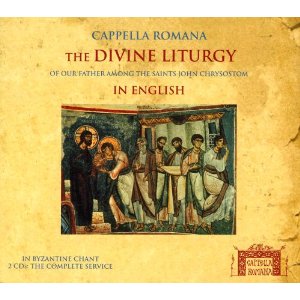
The Divine Liturgy in English by Capella Romana
I received The Divine Liturgy of Our Father Among the Saints John Chrysostom in English by Capella Romana as a Christmas present. It has two CDs and is the first recording of the entire liturgy of St. Chrysostom in English. The recording is excellent. Portions of it are difficult to hear if you are listening to it while driving but that is only because they preserved the dynamics which are often lost in overly compressed modern music. The liner notes contain the text as well as lots of other interesting information. Anyone familiar with the historic liturgy in the Western tradition will notice similarities but also interesting differences. As a Lutheran, I'm not a big fan of the prayers to the saints but they don't detract substantially from the liturgy as a whole. The chanting of Capella Romana does not match the beauty of Fr. Apostolos Hill but is still well done and will no doubt remain the best recording of the complete liturgy of St. Chrysostom available until somebody can get Fr. Apostolos Hill to do it.
Subscribe to:
Posts (Atom)