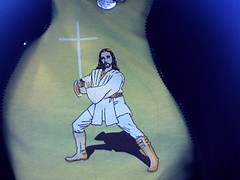
I have not read Love Wins but have read Velvet Elvis, watched most of the NOOMA videos and listened to the numerous interviews with Rob Bell as well as both positive and negative reviews of the new book. Somebody I used to work with has written a very thoughtful review of Rob Bell's new book. From what I can tell, the book is methodologically similar to Velvet Elvis. Rob Bell tells stories about things that happened in his own life while growing up in evangelicalism. He very accurately describes the dated and inaccurate portrait of Jesus that modern evangelicalism gives us and then presents us with his own portrait of Jesus, life, the universe, and everything. (Everyone knows that the real answer is 42.) The problem with Bell (like Plato) is not so much his criticisms--they are often spot on--the problem is the portrait that Bell presents as the solution.
But the purpose of this post is not to criticize Rob Bell--the purpose of this post in this penitential season of Lent is to call us all to repentance. I believe that the real failure of the churches that Rob Bell is reacting against is what makes the popularity of Rob Bell possible as well as the real failure on our own part as individual Christians.
But unfortunately, I must start with Rob Bell. Rob Bell's teachings are actually far worse than most of his critics realize. Unfortunately most of his critics have no knowledge of historic Christian teaching and are only able to respond to buzz words like "universalism." And Bell can easily respond to such people. When somebody gives him a definition of universalism and then asks if he is one, he redefines what the term means and then denies he is a "universalism" without ever responding to what the first person meant when asking if he believes in universalism. But this is only the tip of the iceberg. If you read Velvet Elvis, you will find that in the footnotes he recommends some New Age authors. And if you read Bell carefully you will find that Bell's god resembles the impersonal force of New Age Spirituality more than the God of historic Christianity. Sure, Bell will quote one of the church fathers or a Scriptural passage from time to time, but he always does so out of context--looking for passages that he can twist through the lens of New Age Spirituality. I'm told that in Love Wins Bell compares God to the force in Star Wars and George Lucas intended to promote New Age Spirituality in the Star Wars movies. For Rob Bell, Jesus is the incarnate postmodern paradox. He purposefully ignores some of the rather direct statements of Jesus about God's wrath, sin, and hell and says that Jesus was both very inclusive and very exclusive. If someone teaches that God is an impersonal force, I don't think it really matters very much if the person teaches universalism. Rob Bell is already operating outside of the bounds of historic Christianity and simply attaching a Christian label to New Age Spirituality. Rob Bell has traded in Velvet Jesus for New Age Jesus, or if you prefer, Star Wars Jesus. Rob Bell claims to be orthodox but defines the term "orthodox" in a way that removes all meaning from the word.
But we shouldn't forget that Star Wars Jesus would never exist if not for Velvet Jesus--or at least he would not be as popular. Velvet Jesus is manifested in different ways. Some churches prefer the young and lean Velvet Jesus and other prefer the older and overweight Velvet Jesus but it is still Velvet Jesus. This can be seen in the worship wars. Young Velvet Jesus wants to sing praise choruses and old Velvet Jesus wants to sing revival era hymns. Old Velvet Jesus considers himself to be traditional but the tradition that he follows is a rather new one that has no ties to the ancient church. Velvet Jesus tends to view the Scriptures primarily as an instructional manual for life. Inference is built upon inference and Velvet Jesus will tell you what to wear or how to be a good parent or who to have a successful relationship or if you need to send your kids to a Christian school, or a public school, or homeschool them. Velvet Jesus has an even longer list of unspoken rules that you are expected to follow--Velvet Jesus can't really come up with any Scriptural passages to label your deviance from these rules as sins but breaking any of Velvet Jesus' rules will put you outside of real fellowship with Velvet Jesus. Having a different ethnic identity from Velvet Jesus will often make you a second-class citizen of Velvet Jesus' church. Velvet Jesus has tunnel vision when it comes to the Scriptures. Depending upon which Velvet Jesus you run into, Velvet Jesus might think that the Bible is all about the rapture or Israel or the covenant or predestination or evangelism or having purpose or being successful. Velvet Jesus is comfortable with certain sins but will not tolerate those who struggle with others. Velvet Jesus is afraid of questions because Velvet Jesus is too limited to engage in thoughtful conversation.
Velvet Jesus does not know how to respond when he sees others suffering. Velvet Jesus often assumes that the suffering are suffering because of something that the suffering have done. At the very least, Velvet Jesus thinks that the suffering need to have a more positive attitude because Velvet Jesus knows that if you turn your life over to Velvet Jesus and have a positive attitude that your football team will win all of their games and your potatoes will start growing and your marriage will be restored (and your boss will probably buy you a new car). In this respect we have all bought into the lies of Velvet Jesus--we all tend to believe that those who are suffering have brought it upon themselves because the alternative is too scary. If they did not bring it upon themselves then we could suffer in the same way.
Unfortunately, Velvet Jesus is self-deceptive and most of the time will not admit to doing any of these things. He will confidently engage in his battle with Star Wars Jesus but will not stop to think about what is attractive about Star Wars Jesus. Many are raised within the fellowship of Velvet Jesus. Some are abused by Velvet Jesus. Some attend colleges run by Velvet Jesus where Velvet Jesus teaches them to doubt core teachings of the Christian faith. The professors of course at Velvet Jesus University have learned to avoid certain buzzwords to avoid being fired. But Velvet Jesus University teaches them to doubt. And when they are filled with doubt and start asking questions of their Velvet Jesus pastor, they quickly discover the pastor has no real answers and will not tolerate questions. Some of course fall into sins in college that Velvet Jesus will not tolerate. So where are they to go as sinners and doubters? Star Wars Jesus welcomes them in with the message that God is love and that they have a safe place to doubt. And Star Wars' Jesus' thinking about God is only a couple steps away from Velvet Jesus' language of "what does this passage mean to you?" and "the Lord laid it upon my heart that..."
What is the answer to all this? Repentance. What does the true painting of Jesus look like? Crucified Jesus! Velvet Jesus and Star Wars Jesus both want to avoid even looking at the Crucified Jesus. Star Wars Jesus ignores Him and Velvet Jesus says that he worships the resurrected Christ (despite the fact that Paul said he preached nothing but Christ crucified). Crucified Jesus does not turn away from your suffering, He bears your suffering! Crucified Jesus is not afraid of questions and doubt, nor does He leave you in your doubt. Crucified Jesus brings you Truth because He is the Truth. The Lutheran Confessions say that true worship is "faith struggling against despair." Crucified Jesus does not hang there on the cross to be served by you but to serve you. Crucified Jesus give you forgiveness for your sins and feeds you His body and gives you His blood to drink.
The historic liturgy of the Church is still the best way to deliver Crucified Jesus because the liturgy is centered upon Crucified Jesus. We need not engage in worship wars and market ourselves to a certain segment of the population. Rather we join in the prayers that have been going on since the ancient church. We receive the Crucified Jesus and we join in the heavenly worship--we worship with angels and archangels and all the company of heaven. There is a real mystery in the worship of the Crucified Jesus that has existed since the foundation of the Church--not one that has to be invented by some postmodern paradox. There is a mystery in the Mysteries. We receive the crucified Jesus' very body and blood but we are not told how. We can know with certainty that what the Crucified Jesus' tell us is true because He rose again. We need not debate or speculate as to what our resurrected bodies will look like but we can know that our bodies will be resurrected. Why we suffer in every instance is not explained but we can look to the Crucified Jesus and know that God loves us more than we could ever imagine.
The Crucified Jesus provides a real place for real joy and real suffering because both are found in the Crucified Jesus. When we worship the Crucified Jesus we are united by the Crucified Jesus and not by a common emotional experience. Because we are united to the Crucified Jesus we can be little christs to one another and bear one another's burdens--recognizing our own failure to do so when we see the failure of others to do so for us. The Crucified Jesus has always been true picture given to us in the Scriptures and still will be when the Star Wars Jesus is replaced by an iPad Jesus.
THE ONLY BLOG TO WIN ISSUES ETC. BLOG OF THE WEEK AND BE NOMINATED FOR ISSUES ETC. SOUNDBITE OF THE WEEK WITH A SINGLE POST
Thursday, March 17, 2011
Happy Gertrude and Patrick's Day!
Today we remember Gertrude of Rivelles. According to Wikipedia:
Wikipedia provides a helpful summary of the life of St. Patrick as well as St. Patrick's famous prayer:
Librovox has a free downloadable audiobook that contains the collected works of St. Patrick.
Saint Gertrude of Nivelles (626 – March 17, 659) was abbess of the Benedictine monastery of Nivelles, in present-day Belgium.
She was a daughter of Pepin I of Landen and Saint Itta, and a younger sister of Saint Begga, Abbess of Andenne, Saint Bavo and Grimoald I.
One day, when she was about ten years of age, her father invited Dagobert I and some noblemen to a banquet. When on this occasion she was asked to marry the son of the Duke of Austrasia she indignantly replied that she would marry neither him nor any other man, but that Jesus Christ alone would be her bridegroom.
After the death of her father in 640, her mother Itta, following the advice of Saint Amand, Bishop of Maestricht, erected a double monastery at Nivelles. She appointed her daughter Gertrude as its first abbess, while she herself lived there as a nun, assisting the young abbess by her advice. Among the numerous pilgrims that visited the monastery of Nivelles, there were the two brothers St. Foillan and St. Ultan, both of whom were Irish monks who had lived c.633-651 in East Anglia, and were now on their way from Rome to Peronne[disambiguation needed], where their brother St. Furseus, lay buried. Gertrude and her mother gave them a tract of land called Fosse on which they built a monastery. Ultan was made superior of the new house, while Follian remained at Nivelles, instructing the monks and nuns in Holy Scripture, and was later murdered there by bandits.
After the death of Itta in 652, Gertrude entrusted the interior management of her monastery to a few pious nuns, and appointed some capable monks to attend to the outer affairs, in order that she might gain more time for the study of Holy Scripture, which she almost knew by heart. The large property left by her mother she used for building churches, monasteries and hospices. At the age of thirty-two she became so weak through her continuous abstinence from food and sleep that she found it necessary to resign her office. After taking the advice of her monks and nuns, she appointed her niece, Wulfetrude, as her successor, in December, 658. A day before her death she sent one of the monks to St. Ultan at Fosse to ask whether God had made known to him the hour of her death. The saint answered that she would die the following day during Holy Mass. The prophecy was verified.
Wikipedia provides a helpful summary of the life of St. Patrick as well as St. Patrick's famous prayer:
I bind to myself today The strong virtue of the Invocation of the Trinity: I believe the Trinity in the Unity The Creator of the Universe.
I bind to myself today The virtue of the Incarnation of Christ with His Baptism, The virtue of His crucifixion with His burial, The virtue of His Resurrection with His Ascension, The virtue of His coming on the Judgement Day.
I bind to myself today The virtue of the love of seraphim, In the obedience of angels, In the hope of resurrection unto reward, In prayers of Patriarchs, In predictions of Prophets, In preaching of Apostles, In faith of Confessors, In purity of holy Virgins, In deeds of righteous men.
I bind to myself today The power of Heaven, The light of the sun, The brightness of the moon, The splendour of fire, The flashing of lightning, The swiftness of wind, The depth of sea, The stability of earth, The compactness of rocks.
I bind to myself today God's Power to guide me, God's Might to uphold me, God's Wisdom to teach me, God's Eye to watch over me, God's Ear to hear me, God's Word to give me speech, God's Hand to guide me, God's Way to lie before me, God's Shield to shelter me, God's Host to secure me, Against the snares of demons, Against the seductions of vices,
Librovox has a free downloadable audiobook that contains the collected works of St. Patrick.
Wednesday, March 16, 2011
Heribert of Cologne
Today we commemorate Heribert of Cologne. Wikipedia says:
He was born in Worms, the son of Hugo, count of Worms. He was educated in the school of Worms Cathedral and at the Benedictine Gorze Abbey in Lorraine. He returned to Worms Cathedral to be provost and was ordained a priest in 994.
In the same year Otto III appointed him chancellor for Italy and four years later also for Germany, a position which he held until Otto's death on 23 January 1002. Heribert accompanied Otto to Rome in 996 and again in 997, and was still in Italy when he was elected Archbishop of Cologne. At Benevento he received investiture and the pallium from Pope Sylvester II on 9 July 999, and on the following Christmas Day he was consecrated at Cologne.
In 1002, he was present at the death-bed of the emperor at Paterno. While returning to Germany with the emperor's remains and the imperial insignia, he was held captive for some time by the future Henry II, whose candidacy he at first opposed, but whom he served faithfully subsequently.
Shrine
In 1003 Heribert founded the Abbey of Deutz on the Rhine, at a strongpoint that controlled the western entry to the city of Cologne; when he died in Cologne on March 16, 1021, he was buried in his abbey church...His reported miracles included ending a drought...
Tuesday, March 15, 2011
Loginus
Today we commemorate Longinus. According to Wikipedia:
Longinus is the name given in medieval and some modern Christian traditions to the Roman soldier who pierced Jesus in his side with a lance...while he was on the Cross. The figure is unnamed in the gospels. The Longinus legend further identifies this soldier as the centurion present at the Crucifixion, who testified, "In truth this man was son of God."
Monday, March 14, 2011
Give Up Worship For Lent!
For Lent, I propose a holy fast! A fast from worship! A fast from worship for the rest of your life! The word "worship" comes from the Old English word "weorthscipe" and means "to ascribe worth to God." And I contend that in most circles the idea is taken a step further and worship is understood to mean "to add worth to God." It is thought in the minds of many that when people gather in the name of Christ on Sunday morning it is because we have something that God wants--our worship. The true God is turned into a pagan deity whose existence depends on our worship--much like the deities depicted in the movie Clash of the Titans.
The idea that we gather primarily for the benefit of God is deeply embedded in the vocabulary of almost every denomination even though it varies by denomination. The Roman Catholic has his "holy days of obligation." But surely Protestants have cast all this aside, haven't they? No, in many cases Protestants are worse. The Purpose-Driven crowd very explicitly says that worship is not for you, it's for God--apparently God has low self-esteem. Even the Westminster Confession suggests that the chief end of man is "to glorify God." It goes on to say "and enjoy Him forever" but the emphasis seems to be on "bringing glory to God." God needs a glory recharge. We are even told by some that it is inappropriate for us to cry out to God for help without first engaging in some flowery adoration--because it's very important to suck up to the man upstairs.
The idea that we add worth to God is found in the vocabulary of different church bodies in regard to the sacraments. Certain ideas within Roman Catholic theology are very bad in this regard, but Protestants are far worse. Baptist groups speak of the sacraments as "ordinances" which turn them into a work that we perform. Those in the Reformed camp speak of sacraments as "means of grace" but treat them as ordinances. They teach that the sacraments are transformed into means of grace through the individual partaking worthily. In practice they regard them as ordinances that must be carried out. That is why they practice communion infrequently. If communion were a wonderful gift then they would have communion as often as possible. But they regard it as law, so they do it as infrequently as they feel they can legally. Some attach lengthy forms to make sure that ever i is dotted and every t crossed. The form itself leads to infrequent communion because nobody wants to hear the form read again.
If we do not gather to give God something then why gather at all? We do not gather for worship. We gather for Gottesdienst. We gather for God's service. We do not gather to serve God but to be served by God. We gather to receive the forgiveness of sins from God. We gather to receive God's flesh and blood to eat and drink. God's flesh and blood are gifts, not ordinances. God is not made better by our "worship." God owns the cattle on a thousand hills. He doesn't need anything from us. After we receive God's good gifts we naturally respond in thanksgiving to God, but to put the emphasis on our thanksgiving is absolutely ridiculous. If someone were handing out free money and you were going to go pick some up and then tell the guy thank you, what would you say when your friend asks you what you are doing. "I'm going to go tell someone thank you." No! You would tell him that there is guy and he's giving out all this money and you are going to receive some of it.
I declare a fast--a fast from worship! Receive the good gifts of God. Receive forgiveness of sins! Receive Jesus' very body and blood!
The idea that we gather primarily for the benefit of God is deeply embedded in the vocabulary of almost every denomination even though it varies by denomination. The Roman Catholic has his "holy days of obligation." But surely Protestants have cast all this aside, haven't they? No, in many cases Protestants are worse. The Purpose-Driven crowd very explicitly says that worship is not for you, it's for God--apparently God has low self-esteem. Even the Westminster Confession suggests that the chief end of man is "to glorify God." It goes on to say "and enjoy Him forever" but the emphasis seems to be on "bringing glory to God." God needs a glory recharge. We are even told by some that it is inappropriate for us to cry out to God for help without first engaging in some flowery adoration--because it's very important to suck up to the man upstairs.
The idea that we add worth to God is found in the vocabulary of different church bodies in regard to the sacraments. Certain ideas within Roman Catholic theology are very bad in this regard, but Protestants are far worse. Baptist groups speak of the sacraments as "ordinances" which turn them into a work that we perform. Those in the Reformed camp speak of sacraments as "means of grace" but treat them as ordinances. They teach that the sacraments are transformed into means of grace through the individual partaking worthily. In practice they regard them as ordinances that must be carried out. That is why they practice communion infrequently. If communion were a wonderful gift then they would have communion as often as possible. But they regard it as law, so they do it as infrequently as they feel they can legally. Some attach lengthy forms to make sure that ever i is dotted and every t crossed. The form itself leads to infrequent communion because nobody wants to hear the form read again.
If we do not gather to give God something then why gather at all? We do not gather for worship. We gather for Gottesdienst. We gather for God's service. We do not gather to serve God but to be served by God. We gather to receive the forgiveness of sins from God. We gather to receive God's flesh and blood to eat and drink. God's flesh and blood are gifts, not ordinances. God is not made better by our "worship." God owns the cattle on a thousand hills. He doesn't need anything from us. After we receive God's good gifts we naturally respond in thanksgiving to God, but to put the emphasis on our thanksgiving is absolutely ridiculous. If someone were handing out free money and you were going to go pick some up and then tell the guy thank you, what would you say when your friend asks you what you are doing. "I'm going to go tell someone thank you." No! You would tell him that there is guy and he's giving out all this money and you are going to receive some of it.
I declare a fast--a fast from worship! Receive the good gifts of God. Receive forgiveness of sins! Receive Jesus' very body and blood!
St. Matilda
Today we remember St. Matilda. According to Wikipedia:
As a young girl, she was sent to the convent of Herford, where her grandmother Matilda was abbess and where her reputation for beauty and virtue (probably also her Westphalian dowry) is said to have attracted the attention of Duke Otto I of Saxony, who betrothed her to his recently divorced son and heir, Henry the Fowler. They were married at Wallhausen in 909. As the eldest surviving son, Henry succeeded his father as Saxon duke in 912 and upon the death of King Conrad I of Germany was elected King of Germany (East Francia) in 919. He and Matilda had three sons and two daughters...
After her husband had died in 936, Matilda and her son Otto established Quedlinburg Abbey in his memory, a convent of noble canonesses, where in 966 her granddaughter Matilda became the first abbess. At first she remained at the court of her son Otto, however in the quarrels between the young king and his rivaling brother Henry a cabal of royal advisors is reported to have accused her of weakening the royal treasury in order to pay for her charitable activities. After a brief exile at her Westphalian manors at Enger, where she established a college of canons in 947, Matilda was brought back to court at the urging of King Otto's first wife, the Anglo-Saxon princess Edith of Wessex.
Matilda died at Quedlinburg, she outlived her husband by 32 years. Her and Henry's mortal remains are buried at the crypt of the St. Servatius' abbey church.
Saint Matilda was celebrated for her devotion to prayer and almsgiving; her first biographer depicted her (in a passage indebted to the sixth-century vita of the Frankish queen Radegund by Venantius Fortunatus) leaving her husband's side in the middle of the night and sneaking off to church to pray. St. Mathilda founded many religious institutions, including the canonry of Quedlinburg, which became a center of ecclesiastical and secular life in Germany under the rule of the Ottonian dynasty, as well as the convents of St. Wigbert in Quedlinburg, in Pöhlde, Enger and Nordhausen in Thuringia, likely the source of at least one of her vitae.
Sunday, March 13, 2011
Euphrasia of Egypt
Today we remember Euphrasia of Egypt. According to the infallible Wikipedia:
Euphrasia was the only daughter of Antigonus—a nobleman of the court of Emperor Theodosius I, to whom he was related—and of Euphrasia, his wife. When Antigonus died, his widow and young daughter withdrew together to Egypt, near a monastery of one hundred and thirty nuns.This was less than a century since St. Anthony had established his first monastery, but monasticism in that time had spread with incredible speed.
At the age of seven, Euphrasia begged to take vows and become a nun at the monastery. When her mother presented the child to the abbess, Euphrasia took up an image of Christ and kissed it, saying, "By vow I consecrate myself to Christ." Her mother replied, "Lord Jesus Christ, receive this child under your special protection. You alone doth she love and seek: to you doth she recommend herself." Soon after, Euphrasia's mother became ill and died.
Hearing of her mother's death, the Emperor Theodosius I sent for Euphrasia, whom he had promised in marriage to a young senator. She responded with a letter to the Emperor declining the offer to marry; instead, she requested that her estate be sold and divided among the poor, and that her slaves be manumitted. The emperor did as she requested shortly before his death in 395.
Another version of her biography states that Euphrasia was raised in the court of Theodosius, and that her mother joined the monastery; Euphrasia joined her as a child. The same version says that it was Theodosius' successor, Arcadius, that commanded her to marry the senator, but she was likewise permitted to remain a nun and give away her property.
Euphrasia was known for her humility, meekness, and charity; her abbess often advised her to perform manual labor when she was burdened with temptations. As a part of these labors, she often carried heavy stones from one place to another—once she did so for thirty days at one time. Euphrasia died in the year 410 at the age of thirty.Euphrasia is said to have performed many miracles--including casting out demons and healing the blind.
Subscribe to:
Posts (Atom)

