Thursday, March 10, 2011

Caius and Alexander of Apamea

Today we commemorate the martyrdom of Caius and Alexander. Very little is known about them. They were martyred for opposing the Montanist heresy. The Montanists were similar in some respects to some modern Pentecostal groups and even mainline Protestantism. The Montanists believed that their own ecstatic prophecies superseded and fulfilled the teachings of the Apostles. They also taught that if a Christian fell from grace he could not be redeemed. Christ speaks to us in the Scriptures and says that the Holy Spirit does not speak of himself but of Christ and so all these sectarian groups that claim to be acting as a mouthpiece of the Holy Spirit are truly acting as a mouthpiece for an unholy spirit. We also read in the Scriptures that if we say we have no sin we are liars and that forgiveness is always found in Christ.

O God, by Whose permission, we are celebrating the heavenly birthday of Thy Holy Martyrs Caius and Alexander, grant that we may rejoice in their companionship in everlasting bliss; through Jesus Christ, Thy Son, our Lord, who liveth and reigneth with Thee and the Holy Ghost: ever one God, world without end.Amen.

Wednesday, March 9, 2011

The Forty Holy Martyrs of Sebaste

Not only is today the beginning of the 40 days of Lent, it is also the commemoration of the Forty Holy Martyrs of Sebaste. The following is taken from this website.

When the pagan Licinius ruled the eastern half of the Roman Empire (307-323 AD), it was his evil intent to eliminate Christianity from the lands under his control, and especially, for fear of treason, among the troops. One of his supporters was a cruel man by the name of Agricola who commanded the forces in the Armenian town of Sebaste, in what is now eastern Turkey. Among his soldiers were forty devout Christians who wielded equally well the sword of battle and the sword of the spirit, which is the word of God (Eph. 6:17). These men formed an elite bodyguard. When it came to Agricola's attention that they were Christians, he determined to force them to renounce their' faith and bow down to the pagan gods. He gave them two alternatives:

"Either offer sacrifice to the gods and earn great honors, or, in the event of your disobedience, be stripped of your military rank and fall into disgrace."

The soldiers were thrown into jail to think this over. That night they strengthened themselves singing psalms and praying. At midnight they were filled with holy fear upon hearing the voice of the Lord: "Good is the beginning of your resolve, but he who endures to the end will be saved" (Matt. 10:22 ).

The next morning Agrricola summoned them once again. This time he tried to persuade them by flattering words, praising their valor and their handsomeness. When the soldiers remained unmoved, they were again thrown into prison for a week to await the arrival of Licius, a prince of some authority.

During this time they prepared themselves for the trial of martyrdom. One of them, Cyrion by name, exhorted his fellow soldiers:

"God so ordained that we made friends with each other in this temporary life; let us try not to separate even in eternity; just as we have been found plea sing to a mortal king, so let us strive to be worthy of the favor of the immortal King, Christ our God."

Cyrion reminded his comrades in arms how God had miraculously helped them in time of battle and assured them that He would not forsake them now in their battle against the invisible enemy. When Licius arrived, the soldiers marched to the interrogation singing the psalm, "O God, in Thy name save me" (Ps. 53), as they always did when entering upon the field of contest.

Licius repeated Agricola's arguments of persuasion, alternating between threats and flattery. When he saw that words were of no avail, he ordered the soldiers sent to jail while he thought up a form of torture sure to change their minds.

After prayers that night, for a second time the soldiers heard the voice of the Lord:

"He who believes in Me, though he die, yet shall he live. Be bold and have no fear of short-lived torment which soon passes; endure...that you may receive crowns."

The next day the soldiers were led to a lake. It was winter and a frosty wind was blowing. The soldiers were stripped of their clothes and ordered to stand through the night in the freezing waters. A guard was set to watch over them. In order to tempt the holy warriors of Christ, warm baths were set up on the side of the lake. Anyone who agreed to sacrifice to the idols could flee the bitterly cold waters and warm his frozen bones in the baths. This was a great temptation which in the first cruel hour of the night overpowered one of the soldiers. Scarcely had he reached the baths, however, than he dropped to the ground and died.

Seeing this, the rest of the soldiers prayed the more earnestly to God: "Help us, O God our Saviour, for here we stand in the water and our feet are stained with our blood; ease the burden of our oppression and tame the cruelty of the air; O Lord our God-on Thee do we hope, let us not be ashamed, but let all understand that we who call upon Thee have been saved."

Their prayer was heard. In the third hour of the night a warm light bathed the holy martyrs and melted the ice. By this time all but one of the guards had fallen asleep. The guard who was still awake had been amazed to witness the death of the soldier who had fled to the baths and to see that those in the water were still alive. Now, seeing this extraordinary light, he glanced upward to see where it came from and saw thirty-nine radiant crowns descending onto the heads of the saints, immediately, his heart was enlightened by the knowledge of the Truth. He roused the sleeping guards and, throwing off his clothes, ran into the lake shouting for all to hear, "I am a Christian too!" His name was Aglaius, and he brought the number of martyrs once again to forty.

The next morning the evil judqes came to the lake and were enraged to find that not only were the captives still alive, but that one of the guards had joined them. The martyrs were then taken back to prison and subjected to torture; the bones of their legs were crushed by sledge-hammers. The mother of one of the youngest, Heliton, stood by and encouraged them to endure this trial. To their last breath the martyrs sang out, "Our help is in the name of the Lord," and they all gave up their souls to God. Only Meliton remained alive, though barely breathing.

Taking her dying son upon her shoulders, the mother followed the cart on which the bodies of the soldiers were being taken to be burned. When her son at last gave up his soul, she placed him on the cart with his fellow athletes of Christ.

The funeral-pyre burned out leaving only the martyrs' bones. Knowing that Christians would collect these relics to the eternal glory of the martyrs and their God, the judges ordered them to be thrown into the nearby river. That night, however, the holy martyrs appeared to the blessed bishop of Sebaste and told him to recover the bones from the river. Together with some of his clergy, the bishop went secretly that night to the river where the bones of the martyrs shone like stars in the water, enabling them to be collected to the very last fragment. So also do the holy martyrs shine like stars in the world, encouraging and inspiring believers everywhere to be faithful to Christ even to the end.

Thus they finished the good course of martyrdom in 320, and their names are: Acacius, Aetius, Aglaius, Alexander, Angus, Athanasius, Candidus, Chudion, Claudius, Cyril, Cyrion, Dometian, Domnus, Ecdicius, Elias, Eunoicus, Eutyches, Eutychius, Flavius, Gaius, Gorgonius, Helianus, Herachus, Hesychius, John, Lysimachus, Meliton, Nicholas, Philoctemon, Priscus, Sacerdon, Severian, Sisinius, Smaragdus, Theodulus, Theophilus, Valens, Valerius, Vivianus, and Xanthias.
O God, by Whose grace, we are celebrating the heavenly birthday of Thy Holy Martyrs: grant that we may rejoice in their companionship in everlasting bliss; through Jesus Christ our Lord, who liveth and reigneth with Thee and the Holy Ghost, ever one God, world without end. Amen.

Tuesday, March 8, 2011

Happy St. Philemon the Flute Player Day!

From the resources that are available on-line there appear to be a couple of different but similar stories in regards to the martyrdom of St. Philemon the Flute Player. The Greek Orthodox Archdiocese of Australia's website has a retelling of the events that I post below.

During the reign of Diocletian (284-305 AD), the Governor of Antinoe in the Thebaid of Upper Egypt was Arian, a fierce persecutor who had sent many Christians to a violent death, among them Sts Timothy, Maura, and Sabine. When he had imprisoned 37 Christians for their confession of faith, one of them, named Apollonios, a reader of the Church, lost his courage at the sight of the instruments of torture, and thought how he might escape torments without denying Christ. He gave money to Philemon, a flute-player and a pagan, that he might put on Apollonios' clothes and offer sacrifice before Arian, so that all would think Apolionios to have done the Governor's will, and he might be released. Philemon agreed to this, but when the time came to offer sacrifice, enlightened by divine grace, he declared himself a Christian instead. He and Apollonios, who also confessed Christ when the fraud was exposed, were both beheaded. Before beheading them, Arian had commanded that they be shot with arrows, but while they remained unharmed, Arian himself was wounded by one of the arrows; St Philemon foretold that after his martyrdom, Arian would be healed at his tomb. When this came to pass, Arian, the persecutor who had slain so many servants of Christ, himself believed in Christ and was baptized with four of his bodyguards. Diocletian heard of this and had Arian and his body-guards brought to him. For their confession of Christ, they were cast into the sea, and received the crown of life everlasting.

Monday, March 7, 2011

Happy Thomas Aquinas Day!

The Daily Divine Service Book marks today as the commemoration of Thomas Aquinas. Because of my opposition to Aquinas' belief that revelation can never contradict reason I considered posting some quotes by Etienne Tempier but decided instead to post some of the better things Aquinas had to say as well as some helpful words from Sasse.

"It should be noted that though many might write concerning Catholic truth, there is this difference: that those who wrote the canonical Scripture, the Evangelists and Apostles, and others of this kind, so constantly assert it that they leave no room for doubt. That is his meaning when he says ‘we know his testimony is true.’ Galatians 1:9, “If anyone preach a gospel to you other than that which you have received, let him be anathema!” The reason is that only canonical Scripture is a measure of faith. Others, however, so wrote of the truth that they should not be believed save insofar as they say true things." - Thomas Aquinas, Lectures on the Gospel of John, ed. P. Raphaelis Cai, O.P., Editio V revisa (Romae: Marietti Editori Ltd., 1952) n. 2656, p. 488.

"The precepts of the Law, which man is bound to fulfil, concern acts of virtue which are the means of attaining salvation. Now an act of virtue, as stated above (Q[60], A[5]) depends on the relation of the habit to its object. Again two things may be considered in the object of any virtue; namely, that which is the proper and direct object of that virtue, and that which is accidental and consequent to the object properly so called. Thus it belongs properly and directly to the object of fortitude, to face the dangers of death, and to charge at the foe with danger to oneself, for the sake of the common good: yet that, in a just war, a man be armed, or strike another with his sword, and so forth, is reduced to the object of fortitude, but indirectly. Accordingly, just as a virtuous act is required for the fulfilment of a precept, so is it necessary that the virtuous act should terminate in its proper and direct object: but, on the other hand, the fulfilment of the precept does not require that a virtuous act should terminate in those things which have an accidental or secondary relation to the proper and direct object of that virtue, except in certain places and at certain times. We must, therefore, say that the direct object of faith is that whereby man is made one of the Blessed, as stated above (Q[1], A[8]): while the indirect and secondary object comprises all things delivered by God to us in Holy Writ, for instance that Abraham had two sons, that David was the son of Jesse, and so forth. Therefore, as regards the primary points or articles of faith, man is bound to believe them, just as he is bound to have faith; but as to other points of faith, man is not bound to believe them explicitly, but only implicitly, or to be ready to believe them, in so far as he is prepared to believe whatever is contained in the Divine Scriptures. Then alone is he bound to believe such things explicitly, when it is clear to him that they are contained in the doctrine of faith" -Thomas Aquinas, Summa Theologica, Part 2 of Part 2, Q.1, A. 9

"This doctrine is especially based upon arguments from authority, inasmuch as its principles are obtained by revelation: thus we ought to believe on the authority of those to whom the revelation has been made. Nor does this take away from the dignity of this doctrine, for although the argument from authority based on human reason is the weakest, yet the argument from authority based on divine revelation is the strongest. But sacred doctrine makes use even of human reason, not, indeed, to prove faith (for thereby the merit of faith would come to an end), but to make clear other things that are put forward in this doctrine. Since therefore grace does not destroy nature but perfects it, natural reason should minister to faith as the natural bent of the will ministers to charity. Hence the Apostle says: "Bringing into captivity every understanding unto the obedience of Christ" (2 Cor. 10:5). Hence sacred doctrine makes use also of the authority of philosophers in those questions in which they were able to know the truth by natural reason, as Paul quotes a saying of Aratus: "As some also of your own poets said: For we are also His offspring" (Acts 17:28). Nevertheless, sacred doctrine makes use of these authorities as extrinsic and probable arguments; but properly uses the authority of the canonical Scriptures as an incontrovertible proof, and the authority of the doctors of the Church as one that may properly be used, yet merely as probable. For our faith rests upon the revelation made to the apostles and prophets who wrote the canonical books, and not on the revelations (if any such there are) made to other doctors. Hence Augustine says (Epis. ad Hieron. xix, 1): "Only those books of Scripture which are called canonical have I learned to hold in such honor as to believe their authors have not erred in any way in writing them. But other authors I so read as not to deem everything in their works to be true, merely on account of their having so thought and written, whatever may have been their holiness and learning." -Thomas Aquinas, Summa Theologica, The Nature and Extent of Sacred Doctrine, Q8. Whether Sacred Doctrine Is A Matter of Argument?

"Sacred Scripture, since it has no science above itself, can dispute with one who denies its principles only if the opponent admits some at least of the truths obtained through divine revelation; thus we can argue with heretics from texts in Holy Writ, and against those who deny one article of faith, we can argue from another. If our opponent believes nothing of divine revelation, there is no longer any means of proving the articles of faith by reasoning, but only of answering his objections---if he has any---against faith. Since faith rests upon infallible truth, and since the contrary of a truth can never be demonstrated, it is clear that the arguments brought against faith cannot be demonstrations, but are difficulties that can be answered."-Thomas Aquinas, Summa Theologica, The Nature and Extent of Sacred Doctrine, Q. Whether Sacred Doctrine is a Matter of Argument?

All of the above can be found on this very helpful blog.

“Lutheran theology differs from Reformed theology in that it lays great emphasis on the fact that the evangelical church is none other than the medieval Catholic Church purged of certain heresies and abuses. The Lutheran theologian acknowledges that he belongs to the same visible church to which Thomas Aquinas and Bernard of Clairvaux, Augustine and Tertullian, Athanasius and Ireneaus once belonged. The orthodox evangelical church is the legitimate continuation of the medieval Catholic Church, not the church of the Council of Trent and the [First] Vatican Council which renounced evangelical truth when it rejected the Reformation. For the orthodox evangelical church is really identical with the orthodox Catholic Church of all times. And just as the very nature of the Reformed Church emphasizes its strong opposition to the medieval church, so the very nature of the Lutheran Church requires it to go to the farthest possible limit in its insistence on its solidarity and identity with the Catholic Church. It was no mere ecclesiastico-political diplomacy which dictated the emphatic assertion in the Augsburg Confession that the teachings of the Evangelicals were identical with those of the orthodox Catholic Church of all ages, and no more was it romanticism or false conservatism which made our church anxious to retain as much of the old canonical law as possible, and to cling tenaciously to the old forms of worship.”-Hermann Sasse, Here We Stand, Augsburg Publishing House, 1938, pp. 110-11.

I found the above quote on this excellent blog.

Friday, March 4, 2011

Vote For Me For Issues Etc. Soundbite of the Week

I have been nominated for Issues Etc. Soundbite of the Week...well, sort of. It's actually Jeff Schwartz singing my Blog Post when I won Blog of the Week last week. You can make history by making my blog of the week a winner for soundbite of the week!

Vote before 4:30pm(EST) today (618) 223-8384, talkback@issuesetc.org, or facebook.com/issuesetc

or

Vote live between 4:30pm and 5pm (EST) today (877) 623-6943, talkback@issuesetc.org, or facebook.com/issuesetc

Tell them you want to vote for Jeff and his musical pick for blog of the week.

Monday, February 28, 2011

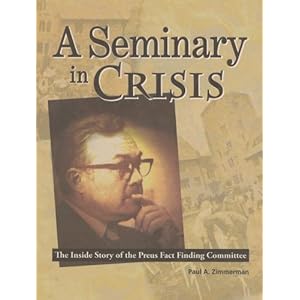
A Seminary In Crisis: The Inside Story of the Preus Fact Finding Committee by Paul Zimmerman

My pastor lent me his copy of A Seminary In Crisis: The Inside Story of the Preus Fact Finding Committee by Paul Zimmerman. This book tells of the events that led to the 1974 walkout at Concordia Seminary. I previously reviewed a book by James C. Burkee about the same events. There is surprisingly little overlap between the two books. Zimmerman's book focuses almost exclusively on the theological divisions while Burkee focuses almost exclusively on the political divisions and political maneuvering. Herman Otten takes center stage in Burkee's book but is barely even mentioned in Zimmerman's book. J.A.O. Preus is prominently featured in both books but each book paints a completely different picture of him. In Burkee's book, Preus is the duplicitous, Nixonesque politician. In Zimmerman's book, Preus is the steadfast defender of the true religion. I don't think either Zimmerman or Burkee are being dishonest. They both provide ample evidence to support their portraits of Preus. But they're coming at Preus from completely different angles. Both are necessary to get a full picture both of what happened and who Preus was. There are times that I think Zimmerman may have overlooked some of Preus' faults and I really think that Burkee de-emphasized the theological issues. Zimmerman says that the lay people played a prominent role in ousting the liberals but doesn't provide evidence. Burkee seems to provide a substantial amount of evidence to show that it was mostly clergy that got involved in the controversy.

Zimmerman is very fair to the liberals throughout the book. He regards them as sincere and is quick to point to areas of agreement that he shared with them. He even mentions friendly conversation that occurred during the controversy. He doesn't demonize anyone. He lays out the theological issues in a matter of fact sort of way and shows the different positions held by various faculty members. Less than half of the book is composed by Zimmerman. The vast majority of the book contains primary source documents from the interviews done by the fact finding committee. There is documentation to the point of insanity. I think Zimmerman has done the church a great service by providing this. But if you read through all of it, it gets very redundant. However, I think it's necessary to have it all laid out there. Lots of summaries and transcripts. I found the transcripts to be the most interesting but I wish they had provided names. From reading articles by some of these people, I think I have a pretty good idea who some of them are.

On occasion, I noticed by comparing the reports in the back to what Zimmerman wrote in the front, that it seems Zimmerman takes a more extreme position than the Synod does on some issues. Zimmerman seems to think that professors should be bound to interpret every passage in the exact same way that the confessions do. This does not seem to be the position of the Synod and seems to be an overreaction to those who would argue that "the narrative of the fall of Adam and Eve into sin discussed in the Confessions is not a doctrinal question, but merely an exegetical question that one is free to debate." (p. 50) It seems like there are other ways of dealing with this problem than trying to bind everyone to every interpretation that the Confessions make.

Also, in reaction to professors who denied that passages historically regarded as messianic are actually about Jesus, Zimmerman takes a very extreme rectilinear approach and seems to want to rule out even the idea that the prophecies may in many cases have an initial fulfillment but that they are only fully fulfilled in Christ.

There was some controversy over the term "inerrancy" and I'm not convinced that is was really helpful in the debate. Zimmerman seems to agree with the position of he Synod. But as I have discussed elsewhere, I think it is actually counterproductive once someone starts thinking deeply about it because it puts authority in original autographs that nobody has.

The main controversy seemed to center around two things: the use of the historical-critical method and standards for fellowship. A small number of professors really went off into crazy town with the historical-critical method. The majority did not go off into crazy town but were open to others going off into crazy town and thought that people in crazy town should be open to take communion and even preach in the churches.

If someone wanted a single book to help them understand what the controversy was all about, Zimmerman's book is what I recommend. But they would probably get a fuller picture if they read Burkee's book second.

Saturday, February 26, 2011

I Won the Coveted Issues Etc. Blog of the Week Award

I won the Issues Etc. Blog of the Week Award. My shameless attempt worked. For those who may have missed it on iTunes here you go:


The original post can be found here. Here are the full lyrics (sung to the Tune of Dr. Hook's "Cover of the Rolling Stone"):

The Issues Etc. Blog of the Week

Well, I'm a Lutheran blogger, I've got golden fingers.
And I'm a pariah everywhere I go.
I blog about Jesus, and I blog about truth,
At zero dollars a show.
I review all kinds of books,
That give me all kind of thrills.
But the thrill I've never known,
Is the thrill that'll gitcha,
When you get your blog,
On the Issues Etc. Blog of the Week.

(Blog of the Week.) Wanna hear my blog on the podcast.
(Issues Etc.) Wanna send five copies of the mp3 to my mother. (Yes.)
(Issues Etc.) Wanna hear my Lutheran blog,
On the Issues Etc. Blog of the Week.

I got a loving wife name a-Laura,
Who washes all my jeans.
I got my little, itty-bitty kids,
Proving original sin.
Now it's all designed to blow my mind,
But my mind won't really be blown.
Like the blow that'll gitcha,
When you get your blog,
On the Issues Etc. Blog of the Week.

(Blog of the Week.) Wanna hear my blog on the podcast.
(Issues Etc.) Wanna send five copies of the mp3 to my mother. (Yes.)
(Issues Etc.) Wanna hear my Lutheran blog,
On the Issues Etc. Blog of the Week.

I got a lot of theological books,
That help me know what to say.
I got a genuine Book of Concord,
That's teachin' me a better way.
I got all the friends that Facebook can give me,
So I never have to be alone. (No.)
And I keep gettin' more "likes,"
But I can't get my blog,
On the Issues Etc. Blog of the Week.

(Blog of the Week.) Wanna hear my blog on the podcast.
(Issues Etc.) Wanna send five copies of the mp3 to my mother. (Yes.)
(Issues Etc.) Wanna hear my Lutheran blog,
On the Issues Etc. Blog of the Week...
(Blog of the Week.) Wanna hear my blog on the podcast.