Luke 22:36 (ESV) He said to them, “But now let the one who has a moneybag take it, and likewise a knapsack. And let the one who has no sword sell his cloak and buy one.I've seen this verse quoted quite a bit recently in debates over self-defense and firearms. But does the verse really have anything to do with these things at all? First of all, there's a textual variant in the verse. Most Greek manuscripts actually would be translated as, "And the one who has no sword will sell his cloak and buy one." If this reading is accepted, Jesus' words in verse 36b are descriptive rather than prescriptive.But more importantly, the context of the verse must be considered.
Luke 22:35-38 (ESV) And he said to them, “When I sent you out with no moneybag or knapsack or sandals, did you lack anything?” They said, “Nothing.” He said to them, “But now let the one who has a moneybag take it, and likewise a knapsack. And let the one who has no sword sell his cloak and buy one. For I tell you that this Scripture must be fulfilled in me: ‘And he was numbered with the transgressors.’ For what is written about me has its fulfillment.” And they said, “Look, Lord, here are two swords.” And he said to them, “It is enough.”Jesus reminds the Apostles that while he remained with them, they had everything they needed. But the time is coming when they will be persecuted as depicted by the swords. Jesus knows that some of them are already carrying swords and do not trust him protect them. The presence of the swords also indicates that they are the transgressors that Jesus is numbered with. The Apostles are still hoping for some type of revolt. They produce two swords, but rather than saying, "But ten more," Jesus says, "That's enough." They don't understand what Jesus is saying and make the same mistake that some do today in thinking that Jesus is telling them to arm themselves. This is similar in some ways to the Matthew 16 passage where the disciples think Jesus is complaining that they didn't bring any bread. The fact that Jesus' Apostles misunderstood him is confirmed by what happens shortly after this. When Jesus is being arrested, Peter draws a sword and cuts off one of the servant's ears and in Matthew's account Jesus warns that those who live by the sword will die by the sword.
The Apostolic confusion over many of Jesus' words are evident throughout the period prior to the resurrection. But especially after Pentecost, they seem to get what Jesus is saying. And we read of many examples of persecution, but none of the Apostles takes up arms against his persecutors. In order to interpret Jesus' words as being a lesson in self-defense we would have to conclude that Apostles actually did understand Jesus prior to the resurrection but misunderstood him after the resurrection. All but John were martyred and nobody takes up a sword to fight off the Romans or the Jews. This is also the case with the early Christians. During various periods the Christians suffered great persecution, but they didn't take up arms.
If someone breaks into a man's house to harm his family, it is well within the vocation of father to protect his family and stop the intruder by force, but there no Scriptural warrant for self-defense in the case of persecution. Jesus teaches to turn the other cheek and the Book of Revelation shows us that the Lamb conquers through the blood of the martyrs not through the blood of the persecutors.
And the Scriptures simply are not interested in giving us a list of weapons we may or may not own. Societies can decide what restrictions should be placed on weapon ownership based upon what they believe will best protect human life. It is the vocation of the President of the United States to uphold the Constitution and to protect the right to bear arms but if laws are passed that prohibit this right it is the vocation of the citizen to obey these laws. The citizen must only disobey when they are commanded to disobey God and God has not commanded anyone to own any weapon.
Thursday, June 6, 2013
Luke 22:36, Self-Defense, and Firearms


Thursday, May 23, 2013
Help, Mom! There are Arminians Under My Bed!

Monday, May 20, 2013
Patristic Quotations on the Limited Atonement

This is by no means an exhaustive list, and it is not intended to be a representative list. There are a lot of odd statements by the church fathers on the atonement, and a lot of strange theories that some of them adopted. Also, just because they adopted a view of limited atonement (in the sense of understanding that Christ was offered to bear the sins of the elect or in that he redeemed the elect in particular) does not mean that they held to a thoroughly "Calvinist" (what an anachronism to call it that!) understanding of TULIP. This, therefore, provides some patristic views of the atonement.
On the one hand, I applaud the honesty. On the other hand, the parameters of what is trying to show aren't very helpful. I think both Calvinists and non-Calvinists would agree that the Scriptures speak at times in more restricted terms about the atonement and speak of Christ dying in relationship to the church that ultimately receives the benefits of the atonement. So proving that the church fathers sometimes speak this way isn't very beneficial. It's already agreed upon by both parties in the debate. The debate is really over whether or not Christ died for those who are not elect. And really to show that the church fathers taught a limited atonement in the same way that the Calvinists teach a limited atonement you really do have to show that they taught the rest of TULIP because the Limited Atonement as Calvinists understand it, is the logical outcome of the rest of their system. In fact, if somebody denies the other teachings of TULIP but uses language that sounds as if they might be speaking of a limited atonement then you would probably have to conclude that they don't mean the same thing in their exclusive language as the Calvinists believe. At the very least it is required for the church father to teach that if a person falls away from the faith that person never really had faith to begin with. Otherwise, if the church father teaches that Christ died for believers that number would at the very least be greater than the "elect" in the Calvinist system and include those who will not inherit eternal life. This will become more apparent as we look at the concrete examples. The article begins with two quotes from Ambrose.
Ambrose (c. 339-97): Although Christ suffered for all, yet He suffered for us particularly, because He suffered for the Church. Saint Ambrose of Milan, Exposition of the Holy Gospel according to Saint Luke, trans. Theodosia Tomkinson (Etna: Center for Traditionalist Orthodox Studies, 1998), Book VI, §25, p. 201.The first quote teaches that Christ did in fact suffer for all but suffered for the church particularly. This seems similar to what 1 Timothy 4:10 teaches. Ambrose doesn't say in the first quote that Christ only suffered for the church but points to those who eventually receive all the benefits of Christ dying for them.
Latin Text: Et si Christus pro omnibus passus est, pro nobis tamen specialiter passus est; quia pro Ecclesia passus est. Expositio Evangelii secundum Lucam, 6.25, PL 15:1675.
Ambrose (c. 339-97): Great, therefore, is the mystery of Christ, before which even angels stood amazed and bewildered. For this cause, then, it is thy duty to worship Him, and, being a servant, thou oughtest not to detract from thy Lord. Ignorance thou mayest not plead, for to this end He came down, that thou mayest believe; if thou believest not, He has not come down for thee, has not suffered for thee. "If I had not come," saith the Scripture, "and spoken with them, they would have no sin: but now have they no excuse for their sin. He that hateth Me, hateth My Father also." Who, then, hates Christ, if not he who speaks to His dishonor? -- for as it is love's part to render, so it is hate's to withdraw honor. He who hates, calls in question; he who loves, pays reverence. NPNF2: Vol.: Volume X, Of the Christian Faith, Book IV, Chapter 2, §27.
The second quote, I think can be understood in a similar way to the first quote. As long as you remain in unbelief Christ is of no benefit to you. It should also be kept in mind that Ambrose held to the historic doctrines concerning the sacraments. Ambrose taught that baptism regenerates and gives faith and did not deny that some people end up walking away from the faith. Understood in this context, the person who has faith at any point in time has Christ as their savior and does not have Christ as their savior if they depart from the faith. You can find a pretty extensive list of quotations from Ambrose on the atonement here. The next quotation is from Ambrosiaster cited second hand from John Owen:
Ambrosiaster: The people of God hath its own fulness. In the elect and foreknown, distinguished from the generality of all, there is accounted a certain special universality; so that the whole world seems to be delivered from the whole world, and all men to be taken out of all men. See Works of John Owen, Vol. 10, p. 423.First it should be noted that Ambrosiaster is not an actual person. There was a period of time in which this work and others were believed to be the work of Ambrose. When it was discovered that these were not the works of Ambrose the name "Ambrosiaster" was given to them. However, now this work in particular is believed to be the work of Prosper of Aquitaine and has been published in English as The Call of the Nations. Owen seems to have left out a sentence from the original text:
Latin text: Habet ergo populus Dei plenitudinem suam, et quamvis magna pars hominum, salvantis gratiam aut repellat aut negligat, in electis tamen et praescitis, atque ab omnium generalitate discretis, specialis quaedam censetur universitas, ut de toto mundo totus mundus liberatus, et de omnibus hominibus omnes homines videantur assumpti: De Vocatione Gentium, Liber Primus, Caput III, PL 17:1084.
God's people, therefore, has a completeness all its own. It is true that a great part of mankind refuse or neglect the grace of their Saviour. In the elect, however, and the foreknown who were set apart from the generality of mankind, we have a specified totality. Thus the whole world is spoken of as though the whole of it had been liberated, and all mankind as though all men had been chosen. (p. 46)As the quotation indicates and as is made clearer if you read the rest of the section, Prosper is not speaking of the atonement but of election. And it's not as if Prosper doesn't comment on the atonement. He deals with the extent of the atonement on pages 118ff. in the same work. The whole section is worth reading but I'll just quote the beginning of it:
There can, therefore, be no reason to doubt that Jesus Christ our Lord died for the unbelievers and the sinners. If there had been any one who did not belong to these, then Christ would not have died for all. But He did die for all men without exception.To say that Prosper taught a limited atonement in this work is extremely dishonest. Prosper actually sounds very Lutheran in both his approach to predestination and the atonement. On to the next quote.
Hilary of Arles (c. 401-449) commenting on 1 John 2:2: When John says that Christ died for the sins of the "whole world," what he means is that he died for the whole church. Introductory Commentary on 1 John. Gerald Bray, ed., Ancient Christian Commentary on Scripture: New Testament, Vol. XI, James, 1-2 Peter, 1-3 John, Jude (Downers Grove: InterVarsity Press, 2000), p. 177. Latin text: et non pro nostris tantum. set etiam pro totius mundi peccatis; Aecclesiam mundi nomine appellat. Expositio In Epistolas Catholiicas, Incipit Epistola Sancti Iohannis Apostoli, Cap. II, v. 2, PL Supp. 3:118.This quote doesn't really prove anything. This is Hilary of Arles commenting on one specific text and following a specific tradition of interpreting a specific passage. What needs to be proved is that Hilary taught that Christ only died for the elect, not that when commenting on a specific passage Hilary believed it only applied to the elect.
Augustine (354-430): 2. But alongside of this love we ought also patiently to endure the hatred of the world. For it must of necessity hate those whom it perceives recoiling from that which is loved by itself. But the Lord supplies us with special consolation from His own case, when, after saying, "These things I command you, that ye love one another," He added, "If the world hate you, know that it hated me before [it hated] you." Why then should the member exalt itself above the head? Thou refusest to be in the body if thou art unwilling to endure the hatred of the world along with the Head. "If ye were of the world," He says, "the world would love its own." He says this, of course, of the whole Church, which, by itself, He frequently also calls by the name of the world: as when it is said, "God was in Christ, reconciling the world unto Himself." And this also: "The Son of man came not to condemn the world, but that the world through Him might be saved." And John says in his epistle: "We have an advocate with the Father, Jesus Christ the righteous: and He is the propitiation for our sins; and not for ours only, but also [for those] of the whole world." The whole world then is the Church, and yet the whole world hateth the Church. The world therefore hateth the world, the hostile that which is reconciled, the condemned that which is saved, the polluted that which is cleansed. 3. But that world which God is in Christ reconciling unto Himself, which is saved by Christ, and has all its sins freely pardoned by Christ, has been chosen out of the world that is hostile, condemned, and defiled. For out of that mass, which has all perished in Adam, are formed the vessels of mercy, whereof that world of reconciliation is composed, that is hated by the world which belongeth to the vessels of wrath that are formed out of the same mass and fitted to destruction. Finally, after saying, "If ye were of the world, the world would love its own," He immediately added, "But because ye are not of the world, but I have chosen you out of the world, therefore the world hateth you." And so these men were themselves also of that world, and, that they might no longer be of it, were chosen out of it, through no merit of their own, for no good works of theirs had preceded; and not by nature, which through free-will had become totally corrupted at its source: but gratuitously, that is, of actual grace. For He who chose the world out of the world, effected for Himself, instead of finding, what He should choose: for "there is a remnant saved according to the election of grace. And if by grace," he adds, "then is it no more of works: otherwise grace is no more grace." NPNF1: Vol. VII, Tractates on John, Tractate LXXXVII, §2-3, John 15:17-19.
Augustine (354-430): Hence things that are lawful are not all good, but everything unlawful is not good. Just as everyone redeemed by Christ's blood is a human being, but human beings are not all redeemed by Christ's blood, so too everything that is unlawful is not good, but things that are not good are not all unlawful. As we learn from the testimony of the apostle, there are some things that are lawful but are not good. John E. Rotelle, O.S.A., ed., Works of Saint Augustine, Adulterous Marriages, Part 1, Vol. 9, trans. Ray Kearney, O.P., Book One, 15, 16 (Hyde Park: New City Press, 1999), p. 153.Augustine, like Ambrose speaks of redemption in terms of who receives the benefits of the atonement but he also would speak of Christ purchasing redemption for all men. In the example below he says Jesus redeemed Judas:
To suffer indeed He had come, and He punished him through whom He suffered. For Judas the traitor was punished, and Christ was crucified: but us He redeemed by His blood, and He punished him in the matter of his price. For he threw down the price of silver, for which by him the Lord had been sold; and he knew not the price wherewith he had himself by the Lord been redeemed. This thing was done in the case of Judas. “Exposition on the Book of the Psalms,” in The Nicene and Post-Nicene Fathers, First Series, 8:309.
Of this death the Apostle Paul says, “Therefore all are dead, and He died for all, that they which live should not henceforth live unto themselves, but unto Him which died for them and rose again.” Thus all, without one exception, were dead in sins, whether original or voluntary sins, sins of ignorance, or sins committed against knowledge; and for all the dead there died the one only person who lived, that is, who had no sin whatever, in order that they who live by the remission of their sins should live, not to themselves, but to Him who died for all, for our sins, and rose again for our justification, that we, believing in Him who justifies the ungodly, and being justified from ungodliness or quickened from death, may be able to attain to the first resurrection which now is. ,“The City of God and Christian Doctrine,” in The Nicene and Post-Nicene Fathers, First Series. 2:245.
You can find a more extensive list of quotations from Augustine on the atonement here.
Chrysostom (349-407) on Hebrews 9:28. "So Christ was once offered.": By whom offered? evidently by Himself. Here he says that He is not Priest only, but Victim also, and what is sacrificed. On this account are [the words] "was offered." "Was once offered" (he says) "to bear the sins of many." Why "of many," and not "of all"? Because not all believed, For He died indeed for all, that is His part: for that death was a counterbalance against the destruction of all men. But He did not bear the sins of all men, because they were not willing. NPNF1: Vol. XIV, Epistle to the Hebrews, Homily 17.This is another extraordinarily dishonest quote because Chrysostom explains what he means by "did not bear the sins" in the very words that follow:
And what is [the meaning of] “He bare the sins”? Just as in the Oblation we bear up our sins and say, “Whether we have sinned voluntarily or involuntarily, do Thou forgive,” that is, we make mention of them first, and then ask for their forgiveness. So also was it done here. Where has Christ done this? Hear Himself saying, “And for their sakes I sanctify Myself.” (John xvii.19.) Lo! He bore the sins. He took them from men, and bore them to the Father; not that He might determine anything against them [mankind], but that He might forgive them. “Unto them that look for Him shall He appear” (he says) “the second time without sin unto salvation.” What is “without sin”? it is as much as to say, He sinneth not. For neither did He die as owing the debt of death, nor yet because of sin. But how “shall He appear”? To punish, you say. He did not however say this, but what was cheering; “shall He appear unto them that look for Him, without sin unto salvation.” So that for the time to come they no longer need sacrifices to save themselves, but to do this by deeds. Chrysostom, “Homilies on the Gospel of St. John and the Epistles to the Hebrews,” in The Nicene and Post-Nicene Fathers, 14:447-448.So Chrysostom explains himself as meaning that when he says "did not bear the sins" he means he does not forgive their sins because they do not have faith. He's not saying that Christ only died for the elect. You can find plenty of quotes here that show what Chrysostom believed about the extent of the atonement.
Prosper of Aquitaine (d. 463): He is not crucified with Christ who is not a member of the body of Christ. When, therefore, our Saviour is said to be crucified for the redemption of the whole world, because of his true assumption of the human nature, yet may he be said to be crucified only for them unto whom his death was profitable. . . . Diverse from these is their lot who are reckoned amongst them of whom is is said, 'the world knew him not.' Latin text: Non est autem crucifixus in Christo, qui non est membrum corporis Christi, nec est membrum corporis Christi, qui non per aquam et Spiritum sanctum induit Christum. Qui ideo in infirmitate nostra communionem subiit mortis, ut nos in virtute ejus haberemus consortium resurrectionis. Cum itaque rectissime dicatur Salvator pro totius mundi redemptione crucifixus, propter veram humanae naturae susceptionem, et propter communem in primo homine omnium perditionem: potest tamen dici pro his tantum crucifixus quibus mors ipsius profuit. . . . Diversa ergo ab istis sors eorum est qui inter illos censentur de quibus dicitur; Mundus eum non cognovit. Responsiones ad Capitula Gallorum, Capitulum IX, Responsio, PL 51:165.
Prosper of Aquitaine (d. 463): Doubtless the propriety of redemption is theirs from whom the prince of this world is cast out. The death of Christ is not to be so laid out for human-kind, that they also should belong unto his redemption who were not to be regenerated. Latin text: Redemptionis proprietas haud dubie penes illos est, de quibus princeps mundi missus est foras, et jam non vasa diaboli, sed membra sunt Christi. Cujus mors non ita impensa est humano generi, ut ad redemptionem ejus etiam qui regenerandi non erant pertinerint. Responsiones ad Capitula Objectionum Vincentianarum, Capitulum Primum, Responsio, PL 51:178.
I think Prosper of Aquitaine's position on the extent of the atonement has been dealt with sufficiently above in the "Ambrosiaster" section. But you can read more quotes from Prosper here.
Theodoret of Cyrrhus (393-466) commenting on Hebrews 9:27-28: As it is appointed for each human being to die once, and the one who accepts death's decree no longer sins but awaits the examination of what was done in life, so Christ the Lord, after being offered once for us and taking up our sins, will come to us again, with sin no longer in force, that is, with sin no longer occupying a place as far as human beings are concerned. He said himself, remember, when he still had a mortal body, "He committed no sin, nor was guile found in his mouth." It should be noted, of course, that he bore the sins of many, not of all: not all came to faith, so he removed the sins of the believers only. Robert Charles Hill, Theodoret of Cyrus: Commentary on the Letters of St. Paul, Vol. 2 (Brookline: Holy Cross Orthodox Press, 2001), p. 175.
I think this is best understood in the same way that Chrysostom's statement is understood. He's not speaking of Christ only dying for the elect but of those who believe receiving forgiveness. As he writes elsewhere:
"By raising the flesh He has given the promise of resurrection to us all, after giving the resurrection of His own precious body as a worthy pledge of ours. So loved He men even when they hated Him that the mystery of the economy fails to obtain credence with some on account of the very bitterness of His sufferings, and it is enough to show the depths of His loving kindness that He is even yet day by day calling to men who do not believe. And He does so not as though He were in need of the service of men -- for of what is the Creator of the universe in want? -- but because He thirsts for the salvation of every man. Grasp then, my excellent friend, His gift; sing praises to the Giver, and procure for us a very great and right goodly feast." (Theodoret, Letter LXXVI To Uranius, Governor of Cyprus)Now on to the quotes from Bede:
Bede (672/673-735) commenting on 1 John 2:1: The Lord intercedes for us not by words but by his dying compassion, because he took upon himself the sins which he was unwilling to condemn his elect for. On 1 John. Gerald Bray, ed., Ancient Christian Commentary on Scripture: New Testament, Vol. XI, James, 1-2 Peter, 1-3 John, Jude (Downers Grove: InterVarsity Press, 2000), p. 177. Latin text: Interpellat ergo pro nobis Dominus, non voce, sed miseratione, quia quod damnare in electis noluit, suscipiendo servavit. In Primam Epistolam S. Joannis, Caput II, PL 93:89.
Bede (672/673-735) commenting on 1 John 2:2: In his humanity Christ pleads for our sins before the Father, but in his divinity he has propitiated them for us with the Father. Furthermore, he has not done this only for those who were alive at the time of his death, but also for the whole church which is scattered over the full compass of the world, and it will be valid for everyone, from the very first among the elect until the last one who will be born at the end of time. This verse is therefore a rebuke to the Donatists, who thought that the true church was to be found only in Africa. The Lord pleads for the sins of the whole world, because the church which he has bought with his blood exists in every corner of the globe. On 1 John. Gerald Bray, ed., Ancient Christian Commentary on Scripture: New Testament, Vol. XI, James, 1-2 Peter, 1-3 John, Jude (Downers Grove: InterVarsity Press, 2000), p. 178. Latin text: Qui per humanitatem interpellat pro nobis apud Patrem, idem per divinitatem propitiatur nobis cum Patre. . . . Non pro illis solum propitiatio est Dominus, quibus tunc in carne viventibus scribebat Joannes, sed etiam pro omni Ecclesia quae per totam mundi latitudinem diffusa est, primo nimirum electo usque ad ultimum qui in fine mundi nasciturus est porrecta. Quibus verbis Donatistarum schisma reprobat, qui in Africae solum finibus Ecclesiam Christi esse dicebant inclusam. Pro totius ergo mundi peccatis interpellat Dominus, quia per totum mundum est Ecclesia, quam suo sanguine comparavit. In Primam Epistolam S. Joannis, Caput II, PL 93:90Bede is commenting on a specific text and pretty much doing what others have done with this specific text but it hardly proves a limited atonement. From all of this it seems to me that Gottschalk in the 9th Century was actually the first to hold to the limited atonement. He also held to a heretical teaching on the Trinity that amounted to a sort of Tritheism. But I'm just very disturbed by the dishonesty in the quotes above.
Wednesday, May 15, 2013
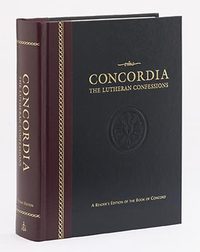
Book of Concord FTW
Friday, May 3, 2013
The Trinitarian Argument For the Limited Atonement

The first problem with this argument is epistemological. The argument assumes that through our fallen human reason we can get inside of God's head and figure out what God would do in a particular circumstance. God explicitly says in Scripture that His ways are not our ways and His thoughts are not our thoughts but the argument assumes that they are. In reality, everything about the atonement is mysterious, paradoxical, and runs counter to our human reason and yet they latch on to one piece of it and think they can arrive at some theological truth via human reason.
The Trinity itself is revealed in Scripture but is beyond all human reason. God is one being and three persons as Scripture tells us, but whenever someone tries to explain this in a way that is reasonable they end up denying either the threeness or oneness of God. God is far greater than any of us and it shouldn't be any surprise that God is incomprehensible apart from His self-revelation. It's not surprising that most Calvinist churches have abandoned the Trinitarian worship of the historic liturgy in favor of more reasonable forms of worship.
The incarnation defies all human reason. God dying for sinners defies all human reason. The meaning of the atonement cannot be arrived at with our reason but must be revealed to us by God. I would argue that any argument that demands that the atonement be reasonable has presuppositions behind it that if taken to their logical conclusion would lead to a denial of the atonement completely. There is nothing reasonable about God dying for us sinners who killed Him. Annihilation would be reasonable. I think if the Calvinist presuppositions are taken seriously, not creating us in the first place would actually be the only reasonable option. The doctrine of the limited atonement is in fact a distraction from the absolutely confounding and offensive reality of the crucifixion itself. It turns our eyes away from God bleeding and dying for us to the hidden God which is not revealed but what we think we can figure out.
The limited atonement is also contrary to the plain teachings of Scripture. The Calvinist has explanations for all the passages you can produce just like every theology has some sort of answer for passages that contradict it, but it's hard to believe that Jesus or the Apostles would speak in the way that they do if they actually believed in a limited atonement. I've never heard Calvinists speak in the way that the Scriptures speak about the atonement without lots of qualifications and insertions. A Calvinist would never speak of those who deny the Master who bought them unless they are preaching on that specific passage and then they will spend the first half of the sermon telling you about why it doesn't mean what it sounds like it means. The Calvinist will never say with the Apostle Paul that all men who died in Adam were justified in Christ on the cross.
There is no conflict between the Father, Son, and Holy Spirit. God loved the world and sent His Son to die for it. God desires the salvation of all men. We may not understand why God does not then elect all men but it's foolish to try to twist the clear passages of Scripture to make God act in a way that we think is appropriate because the crucifixion shows that God does not act in ways that we think are appropriate.
The Trinitarian argument for the limited atonement seems to assume a god who doesn't do more than he absolutely has to. But God is gracious and mericful and bestows His good gifts upon all men. The promises of God in Christ are far too wonderful to consider reasonable or try to explain away. Instead we should cling to them in faith. Christ died for sinners. That's good news because you're a sinner.
Thursday, May 2, 2013
Would the Apostles Say What They Said If They Believed What You Believe?

Tuesday, April 30, 2013
Owen's Syllogism and the Limited Atonement

The Father imposed His wrath due unto, and the Son underwent punishment for, either:
1. All the sins of all men.
2. All the sins of some men, or
3. Some of the sins of all men.
In which case it may be said:
That if the last be true, all men have some sins to answer for, and so, none are saved. That if the second be true, then Christ, in their stead suffered for all the sins of all the elect in the whole world, and this is the truth. But if the first be the case, why are not all men free from the punishment due unto their sins? You answer, “Because of unbelief.” I ask, Is this unbelief a sin, or is it not? If it be, then Christ suffered the punishment due unto it, or He did not. If He did, why must that hinder them more than their other sins for which He died? If He did not, He did not die for all their sins!Owen concludes that if the first is true, then Jesus did not die for the sin of unbelief. The problem with this reasoning is that the Scriptures say that damnation is the result of unbelief. So, Owen's argument is really with the Scriptures themselves. The Scriptures never say that the damnation is the result of Jesus not dying for anyone. In fact, we have examples in Scripture of people whom the Scriptures say Jesus bought but that end up denying Christ and end up perishing. No matter how much Owen tries to make these texts say something different, it's pretty clear that anyone who held to a limited atonement would not say the things that Scripture says. There's a reason why you don't really find anyone teaching a doctrine of limited atonement until the medieval scholastic period.
The Scriptures use a variety of language to speak of Christ's atonement. Sometimes they speak of the atonement as a ransom. Some of the church fathers concluded that since in a human ransom one party must be paid for another that in the atonement Christ is paying the Devil. The Scriptures never say that Christ is paying the Devil but these church fathers pushed the picture further than Scripture does. Owen and the Calvinists essentially do the same thing with the legal language used in Scripture. In an ordinary legal setting if one person takes the place of another for punishment, the guilty person cannot be punished for the crime. But the Scriptures never teach us that if Christ suffered for someone that person will be saved on the last Day and that it would be unjust to punish that person. In Romans 5 we learn that all who died in Adam are justified in Christ and yet we learn elsewhere that this justification is received through faith which itself is a gift of God. The only way to say that someone was not justified upon the cross according to Romans 5 is to say that they did not die in Adam. The only reason given in Scripture for why someone who was justified on the cross does not receive that justification is because of unbelief.
Even Owen's argument just by itself leads to absurdity because if Christ did not die for someone it would be hard to explain how unbelief could be a sin. In the Gospel we are called to believe that Christ died for our sins. If Jesus didn't die for that person then it would be sinful for the person to believe that Jesus died for him. The doctrine of the limited atonement has the wrong starting point for doing theology. It starts from the glory of God. But Paul said he preached nothing but Christ-crucified. Christ-crucified is the central teaching of the Scriptures. If you begin with Christ-crucified you don't have to explain away what the Scriptures clearly teach and you can have confidence that Jesus really did die for you and pay for your sins. If Jesus only died for some you can never be certain you are among those for whom Jesus died because if you fall away from the faith you will just have to conclude that you never had faith to begin with.
Subscribe to:
Posts (Atom)